





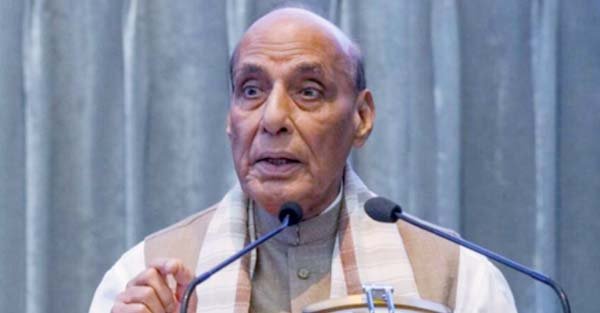
New Delhi, Nov 25 (UNI) Defence Minister Rajnath Singh on Tuesday said that India is entering a “golden era of defence innovation,” crediting the nation’s young entrepreneurs and innovators for transforming India from a buyer into a builder, creator and global leader in cutting-edge defence technologies.
Addressing start-ups, MSMEs, academia and industry partners at the Indian Navy’s Swavlamban 2025 seminar in New Delhi, he urged the ecosystem to stay proactive and future-ready amid a rapidly evolving geopolitical landscape, while calling for a strong, self-reliant domestic supply chain to ensure strategic independence and cost efficiency.
The Defence Minister asserted that the indigenisation movement being witnessed in the country today isn’t just due to policy; but the hard work of all stakeholders. As a result, India is making giant strides towards becoming a technology exporter from an importer.
“If India is rising as a maritime power today, it is due to the contribution of our innovators along with the Navy,” he said.
Sharing insights on the emergence of new dimensions in the field of defence and national security, Singh exhorted the private sector to adopt a profit-plus approach and come up with platforms and systems that become symbols of the world’s trust in India.
“A profit-plus approach encompasses monetary profit, nationalism, a sense of duty and strategic responsibility. Our goal should not be limited to economic activity; it should be treated as a national mission. The private industry must expand its role and move forward at a new pace in production, technology, design and innovation, keeping national interests in mind,” he said.
He also urged the private sector to strive to increase its contribution in defence manufacturing to 50% or more in the coming years.
Highlighting the long-term financial burden of maintenance, repair, overhaul, and spare parts supply for defence equipment imported from foreign countries, the defence minister emphasised the need to minimise import dependency and create a strong and self-reliant domestic supply chain.
“If we strengthen local manufacturing of components and subsystems, our indigenous content will increase rapidly. This will not only enhance capability, but ensure cost efficiency, reliability, and strategic independence. This is possible only when the private sector, start-ups, R&D labs, and government institutions move forward with a shared vision,” he said.
Addressing the gathering, Chief of the Naval Staff Admiral Dinesh K Tripathi stated that with each successive edition, Swavlamban has grown in scope, scale, and participation – evolving from 800 participants in its maiden edition to an impressive gathering of 3,000 last year.
Out of the 565 iDEX challenges announced so far, the Indian Navy owns a significant share of 35%, and Swavlamban has been central to achieving this, he added.
The Chief of the Naval Staff highlighted that the products developed by start-ups and MSMEs through iDEX challenges have not only strengthened the Navy’s capabilities but have also expanded opportunities for their direct procurement by Army, Air Force, Coast Guard and the Central Armed Police Forces, reflecting an integrated whole-of-defence approach that leverages innovation across the armed forces.