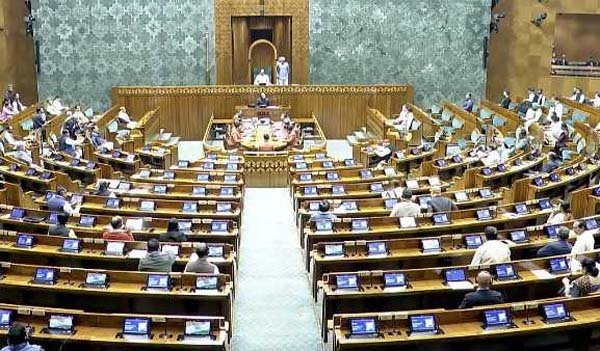





New Delhi, Dec 18 (UNI) The Lok Sabha on Thursday passed the Viksit Bharat – Guarantee for Rozgar and Ajeevika Mission (Gramin) Bill, 2025, abbreviated as VB–G RAM G, despite vociferous protests from opposition parties.
The bill aims to overhaul India’s rural employment framework by providing a statutory guarantee of 125 days of wage employment to rural households, aligning with the national vision of Viksit Bharat @2047.
Union Minister of Rural Development Shivraj Singh Chauhan moved the bill for passage, describing it as a transformative step to strengthen and expand the existing Mahatma Gandhi National Rural Employment Guarantee Act (MGNREGA).
“The main aim of the Bill is to align the rural development framework with the national vision of Viksit Bharat @2047 by providing a strengthened statutory wage-employment guarantee of 125 days per financial year to rural households whose adult members volunteer for unskilled manual work, thus enabling their greater participation in the expanded livelihood security system,” he said.
The legislation focuses on empowerment, growth, convergence, and saturation of multiple government schemes through initiatives such as the ‘Viksit Gram Panchayat Plans’ coordinated via the PM Gati Shakti programme. It also envisions an integrated ‘Viksit Bharat National Rural Infrastructure Stack’ to manage rural public works effectively, emphasizing water security, core rural infrastructure, livelihood generation, and climate resilience.
Addressing concerns about agricultural labour availability, Chauhan noted, “Given the enhanced wage-employment guarantee for the rural workforce, ensuring the availability of farm labour during peak agricultural seasons is essential. Accordingly, the Bill empowers states to notify in advance specific periods covering peak sowing and harvesting seasons during which work under this Bill will not be carried out.”
He further explained the funding structure. “Each state government must prepare a scheme to implement the guarantee under this Bill within six months of the Act’s commencement; this will be executed as a Centrally sponsored scheme. The Central government will allocate normative funding to each state based on objective criteria set out in the rules. Any expenditure beyond the approved allocation will be the responsibility of the state governments.”
On wage provisions, the Minister said, “The Central government will notify wage rates for unskilled manual labour under this legislation. Until new rates are set, those under the Mahatma Gandhi NREGA will apply.” He added, “If an eligible applicant is not provided work within the prescribed timeframe as per this Bill, the state government must pay unemployment allowance at the prescribed rate.”
For oversight, Chauhan announced the formation of Central and State Gramin Rozgar Guarantee Councils to monitor implementation and advise on key matters. “Transparency and accountability will be ensured through biometric authentication, spatial technology-based planning, mobile and dashboard monitoring, and weekly public disclosures. The social audit mechanism will be strengthened,” he said.
However, the bill met with intense criticism. Congress leaders demanded referral of the bill to a parliamentary standing committee for a detailed scrutiny. Senior Congress leader Priyanka Gandhi condemned the bill, stating, “No law should be passed based on someone’s whim, ambition and prejudice.”
Congress members protested in Parliament premises, holding photographs of Mahatma Gandhi, in whose name the existing MGNREGA was established.
Congress president and leader of the Opposition in Rajya Sabha Mallikarjun Kharge called the renaming of MGNREGA to VB–G RAM G “not just a name change but a planned assassination of the world’s largest employment scheme.” He accused the government of insulting Mahatma Gandhi and undermining the right to work that has transformed rural India.
“Against the oppression of this authoritarian ruling government, we will fight from Parliament to the streets,” Kharge declared amid protests.
The bill’s passage marks a significant moment in India’s rural development policy, reflecting evolving aspirations and a push for integrated, technology-driven governance. Yet, its future implementation faces scrutiny and debate given its profound impact on millions of rural livelihoods.
VB–G RAM G Bill, 2025 passed amid strong Opposition protests in Lok Sabha