






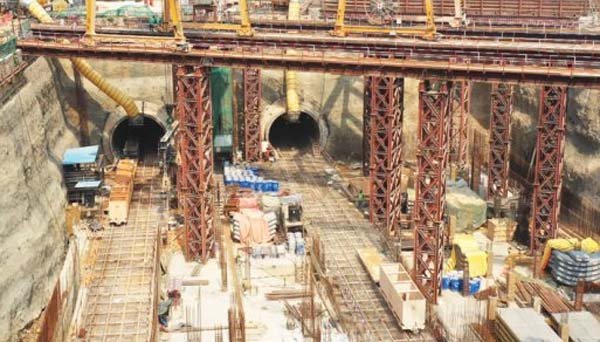
New Delhi, Jan 14 (UNI) Penetrating through high altitude mountains in difficult terrains and connecting inaccessible areas, tunnels have been one of the main features in India’s road infrastructure development programme.
Whether it is the landmark Atal Tunnel, the world’s longest highway tunnel above 10,000 ft stretching 9.02 km bypassing Rohtang Pass, the upcoming mega-tunnel like Zojila that will provide all-weather access to Ladakh, or the record-breaking rail links led by the 12.77-km Tunnel T50, India’s tunnel construction and infrastructure development are set to be among the most crucial contributors in India’s development journey.
The upcoming Zojila tunnel will provide all-weather access to Ladakh, boosting mobility and Defence reach.
‘’Tunnels in India represent more than infrastructure development. They reflect the nation’s determination to overcome geographical challenges. By cutting through mountains and terrain that once limited connectivity, tunnels have enabled year-round transportation and improved access to remote regions and strengthened links between communities,’’ an official spokesman said. From strategic Himalayan tunnels to urban metro networks, these projects are transforming how India moves people, goods, and resources.
India’s tunnel boom is being driven by national highway expansion, alongside strategic border infrastructure, metro rail growth, bullet train corridors, and all-weather connectivity initiatives in remote regions.
Over the past decade, India’s tunnelling capability has transformed, having progressed from traditional drill-and-blast methods to sophisticated technologies. This enables faster, safer, and more complex underground construction. Modern projects now rely on advanced geological mapping and real-time monitoring systems.
Seven tunnels have been constructed in the difficult mountainous terrains of Jammu and Kashmir.
The Atal Tunnel, beneath the snow-laden peaks of the Pir Panjal ranges, provides a high-altitude passage bypassing Rohtang Pass. The tunnel’s strategic significance also lies in ensuring safe, reliable access for Defence movement, besides civilians, under challenging mountain conditions. It is officially recognised as the World’s Longest Highway Tunnel above 10,000 feet.
The Z-Morh/Sonamarg Tunnel, a 12-km engineering marvel carved through mountains at an altitude of over 8,650 feet above sea level, is set to transform travel in Jammu & Kashmir. Built at RS 2,700 crore, it includes a 6.4-km main tunnel, an egress tunnel, and modern approach roads creating an all-weather lifeline between Srinagar and Sonamarg, and further towards Ladakh. No longer will avalanches, landslides, or heavy snowfall cut the region off.
Once paired with the upcoming Zojila Tunnel (2028), the journey will shrink from 49 km to 43 km, with speeds rising from 30 km/hr to 70 km/hr, boosting Defence logistics, winter tourism, adventure sports, and the livelihoods of the people who call these mountains home.
The Sela Tunnel, dedicated to the nation during the Viksit Bharat Viksit North East programme in Itanagar, Arunachal Pradesh, is built by the BRO at 13,000 feet on the Tezpur-Tawang route. The tunnel is constructed at Rs 825 crore, ensuring all-weather connectivity and holding immense strategic value for the Armed Forces while boosting socio-economic growth in the border region.
The Banihal–Qazigund Road Tunnel, constructed at a cost of over Rs 3,100 crore, is an 8.45-km-long twin-tube tunnel designed to significantly improve connectivity between Jammu and Kashmir. The tunnel has reduced the road distance between Banihal and Qazigund by 16 KM and has cut travel time by approximately one and a half hours.
Dr Syama Prasad Mookerjee Tunnel, formerly known as the Chenani–Nashri Tunnel in Jammu & Kashmir is a 9-km-long, twin-tube, all-weather road tunnel connecting Udhampur and Ramban. Built at an elevation of about 1,200 metres in difficult Himalayan terrain, it has reduced travel time between Jammu and Srinagar by nearly two hours while bypassing 41 km of road length.
Tunnel T50, a 12.77-km engineering marvel connecting Khari and Sumber in Jammu & Kashmir, is one of India’s longest transportation tunnels constructed under the Udhampur–Srinagar–Baramulla Rail Link (USBRL) project, forming a crucial rail lifeline between the Kashmir Valley and the rest of the country.
The Zojila Tunnel is emerging as a monumental achievement in India’s infrastructure landscape, cutting through some of the most formidable Himalayan rock formations to establish a dependable, all-weather link between Ladakh and the rest of the country. With nearly 12 km already done, the project, once completed, will become India’s longest road tunnel and Asia’s longest bi-directional tunnel. The project is slated for a 2028 completion. As a critical component of the Srinagar Kargil–Leh National Highway, it promises to enhance both civilian and military mobility across the region.
The Mumbai–Ahmedabad High-Speed Rail corridor has marked a futuristic leap with the breakthrough on its 4.8-km undersea tunnel section. It is a defining feature of the nation’s first bullet train route.
The Rishikesh–Karnaprayag rail line in Uttarakhand is a landmark tunnelling project in the Indian Himalayas. Spanning about 125 km, the alignment passes through some of the most geologically complex and environmentally sensitive Himalayan terrain.
In 2024, India marked a historic breakthrough with the launch of its first underwater metro tunnel in Kolkata, linking Esplanade and Howrah Maidan beneath the Hooghly River.