





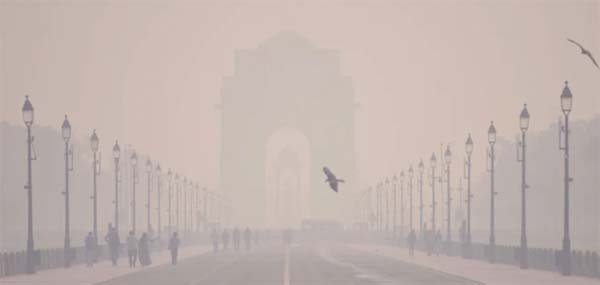
New Delhi, Jan 18 (UNI) Toxic smog blanketed the National Capital Region (NCR) on Sunday as air quality deteriorated sharply, slipping into the ‘severe’ category from ‘very poor’ a day earlier.
At 4 pm, Delhi’s 24-hour rolling average Air Quality Index (AQI) stood at 440, breaching the ‘severe’ threshold of 400, according to the Central Pollution Control Board’s (CPCB) national bulletin. On Saturday, the city’s AQI was recorded at 400. Ghaziabad emerged as the worst-affected city in the country, with AQI levels rising from 394 the previous day to 458, an increase of over 60 points within 24 hours.
Noida and Greater Noida were among other NCR cities breathing foul air, with AQI readings of 430 and 402, respectively, both in the ‘severe’ category. Gurugram and Faridabad fared relatively better, recording AQI levels of 378 (‘very poor’) and 247 (‘poor’).
All 39 air quality monitoring stations in Delhi were marked ‘red’, indicating ‘severe’ air quality. Rohini was the most polluted area in the city, recording an AQI of 480, followed closely by Mundka and Bawana at 479 each, placing them in the ‘severe plus’ category. Nearly half of Delhi’s monitoring stations either breached or hovered close to the ‘severe plus’ threshold.
According to the CPCB, air quality is classified into six categories based on AQI levels: ‘good’ (0–50), ‘satisfactory’ (51–100), ‘moderate’ (101–200), ‘poor’ (201–300), ‘very poor’ (301–400), ‘severe’ (401–450), and ‘severe plus’ (above 450).
While ‘poor’ and ‘very poor’ air quality can cause breathing discomfort, prolonged exposure to ‘severe’ air poses health risks even to healthy individuals and can trigger serious respiratory issues among those with pre-existing conditions. AQI levels in the ‘severe plus’ range are considered extremely hazardous, significantly impairing breathing and disproportionately affecting children, the elderly, and people with chronic illnesses.
Meanwhile, amid rapidly deteriorating air quality in the national capital, the Commission for Air Quality Management (CAQM) invoked Stage 4 of the Graded Response Action Plan (GRAP) on Saturday, a day after imposing Stage 3 measures across Delhi and the NCR.
Under the stricter pollution-curbing measures, schools in the region have been directed to shift to a hybrid mode, while government offices have been urged to operate at 50 per cent capacity to reduce vehicular emissions, a major contributor to the city’s PM2.5 load.