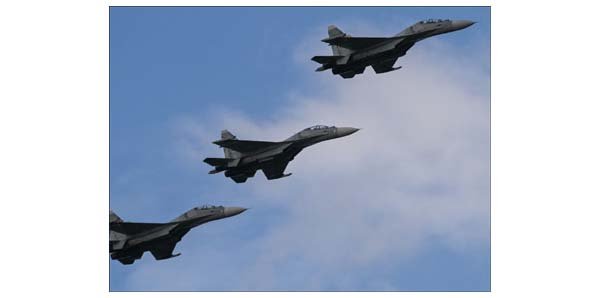






Tallinn, Sep 20 (UNI) In a brazen incursion, three Russian MiG-31 fighter jets entered the Estonian skies and remained there for a total of 12 minutes.
Following this, Estonia’s foreign ministry condemned the incursion as “brazen” and said three Russian MiG-31 fighter jets entered the Estonian skies “without permission on Friday and remained there for a total of 12 minutes” over the Gulf of Finland, as per a report in BBC.
Furious over this incident, Estonia has requested a consultation with other Nato members after Russian warplanes violated its airspace.
A Nato spokesperson said the military alliance “responded immediately and intercepted the Russian aircraft”, calling it “yet another example of reckless Russian behaviour and Nato’s ability to respond”.
To counter the threat, Italy, Finland and Sweden scrambled jets under Nato’s mission to bolster its eastern flank.
However, Russia later denied violating Estonian airspace.
Russia’s defence ministry said the jets were on a “scheduled flight… in strict compliance with international
airspace regulations and did not violate the borders of other states, as confirmed by objective monitoring”.
It further said they flew over neutral Baltic waters, more than 3km (two miles) from Vaindloo Island, which
belongs to Estonia.
Tensions have escalated between the Nato military alliance and Russia since Moscow launched a full-scale
invasion of Ukraine in 2022.
They have risen in the last week, after Poland and Romania – both Nato members – said Russian drones
breached their airspace. In response, Nato pledged to move military assets, including fighter jets, eastwards
to strengthen defence.
Speaking later on Friday, Estonian Prime Minister Kristen Michal said his government had “decided to request
Nato Article 4 consultations” at an urgent meeting.
“Nato’s response to any provocation must be united and strong. We consider it essential to consult with our
allies to ensure shared situational awareness and to agree on our next joint steps,” Michal said.
Article 4 of the Nato treaty formally starts urgent consultations within the 32-member alliance, which ties the
US and many European nations together on collective defence.
It is the second time in a week that a Nato member has requested Article 4 consultations. Earlier, Poland did so
after Russian drones entered its airspace.
US President Donald Trump told reporters he was due to be briefed on the incident later on Friday.
He said: “I don’t love it. I don’t like when that happens. Could be big trouble. But I’ll let you know later”.
Estonia’s foreign ministry earlier said it had summoned the Russian chargé d’affaires “to lodge a protest” over
Friday’s incursion, while top EU diplomat Kaja Kallas described the incident as “an extremely dangerous provocation”.
The minister added Russia had already violated Estonia’s airspace four times in 2025.
Estonia which shares a border with Russia to the east, said the aircraft entered its airspace from the north-east
and were intercepted by Finnish jets over the Gulf of Finland.
Once inside Estonian airspace, Italian F-35 jets, based in Estonia, were deployed under Nato’s Baltic Air Policing
mission to escort the aircraft out.
The government said the Russian jets had no flight plans, had their transponders turned off and also did not
have two-way radio communication with Estonian air traffic control.
Estonian Defence Minister Hanno Pevkur told the BBC: “It is unprecedented that for 12 minutes the Russians
were in our airspace.”
“In this situation, the only right thing to do is to push them out of Estonian airspace,” he added.
PM Michal also said the Russian incursion showed its war of aggression in Ukraine was not proceeding as the
Kremlin had planned.
“The aim is to draw attention and assistance away from Ukraine by forcing Nato countries to focus more on the
defence of their own territories,” he added.
In a post on X, Kallas, who is an Estonian national, said the EU “will continue to support our member states in
strengthening their defences with European resources”.
She also said Russian President Vladimir Putin was “testing the West’s resolve. We must not show weakness”.
Echoing her words, European Commission President Ursula von der Leyen said on X: “We will respond to every
provocation with determination while investing in a stronger Eastern flank.”
“As threats escalate, so too will our pressure,” she added.
Last week, Poland’s military said it had shot down at least three Russian drones, with prime minister Donald
Tusk saying 19 drones were recorded entering Polish airspace.
Meanwhile, Russia insisted the incident was not deliberate, and its defence ministry said there had been “no
plans” to target facilities on Polish soil.
Belarus, a close Russian ally, said the drones entered Polish airspace accidentally after their navigation systems
were jammed.
Several days later, Romania’s defence ministry said it had detected a Russian drone when two F-16 jets were
monitoring the country’s border with Ukraine, after “Russian air attacks on Ukrainian infrastructure on the
Danube [river]”.
Intriguingly, Russia has not commented on the issue.
In response to Russia’s incursions into Poland and Romania, Nato pledged to move troops and fighter jets eastwards.
Planes from the UK, France, Germany and Denmark are all taking part in air defence missions over Poland in a
bid to bolster the alliance’s eastern flank.
Pevkur suggested that Nato needed to “put more focus on the eastern flank” and described it as “our joint
response line in a way, that here in Estonia we keep the front door closed
On Monday, a French jet was scrambled in response to another potential incursion by Russian drones. Nato
said that alert was quickly over.
Three Russian jets violate Estonia’s airspace