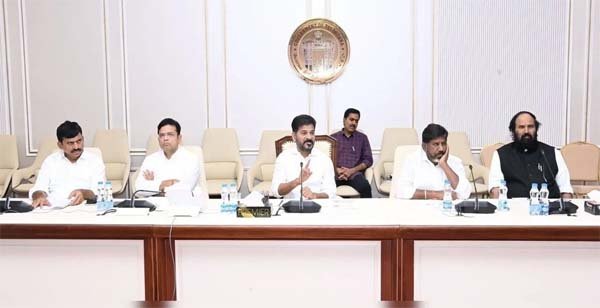




Hyderabad, Feb 24 (UNI) The Telangana Cabinet, chaired by Chief Minister A Revanth Reddy, has approved two landmark welfare schemes for government employees and pensioners, including a Rs 1.20 crore accident insurance cover and a comprehensive cashless health scheme with an annual outlay of Rs 1,056 crore.
In a first-of-its-kind initiative in the country, the State government decided on Monday to extend accident insurance to all serving government employees and pensioners without collecting any premium from beneficiaries. In the event of death due to an accident, the family will receive compensation of Rs 1.20 crore, while a term insurance cover of Rs 10 lakh will apply in cases of natural death of employees up to the age of 60 years.
The scheme will benefit 5.19 lakh regular government employees and 2.38 lakh pensioners, covering a total of 7.57 lakh persons. The Cabinet decided to implement the insurance scheme through bankers, ensuring that there is no financial burden on either the employees or the government. The scheme was earlier implemented successfully for Singareni and Transco employees.
The Cabinet also approved the long-pending Cashless Employee Health Scheme (EHS), which will provide free, cashless medical treatment for employees, pensioners and their dependent family members. The scheme will cover 3.56 lakh regular employees, 2.88 lakh pensioners and their dependents, benefiting about 17.07 lakh people.
Under the scheme, treatment for 1,998 medical procedures will be available in all government hospitals and 652 empanelled private and corporate hospitals.
Each employee will be issued a digital Employee Health Card, and services will be delivered through the Rajiv Aarogyasri Health Care Trust. Employees will contribute 1.5 per cent of their basic pay, with the government making a matching contribution. While employees will contribute Rs 528 crore annually, the government will provide an equal amount, taking the total annual outlay to Rs 1,056 crore.
Briefing the media after the over five-hour-long Cabinet meeting at the Secretariat, Revenue and Information & Public Relations Minister Ponguleti Srinivasa Reddy, along with Ministers Vakiti Srihari and Adluri Laxman Kumar, said the decisions reflected the government’s strong commitment to employee welfare, health and family security.
The Minister also announced that the Legislative Assembly session will begin on March 16, with the Governor’s address to both Houses on the same day, while the State Budget will be presented on March 20.
In addition to employee welfare measures, the Cabinet approved several other important decisions. It cleared the conversion of the Telangana Vaidya Vidhana Parishad (TVVP) into the Directorate of Secondary Health Care (DSH) to strengthen secondary healthcare services and improve fund allocation, procurement and staff payments. The Cabinet also approved major reforms in the Health Department and decided to constitute a special committee under Health Minister Damodar Raja Narasimha to study new hospital management policies.
The Cabinet gave its nod for the expansion of the Hyderabad Metropolitan Development Authority (HMDA) by including four villages in Vikarabad district.
It approved Comprehensive Road Maintenance Programme (CRMP) Phase-2 for developing and maintaining an additional 300 km of roads in Greater Hyderabad at a cost of Rs 3,145 crore. It also cleared the modernisation of the Manjeera Water Supply Scheme and Osman Sagar pipelines to reduce water losses and improve drinking water supply.
The Cabinet further approved initiating the process for taking over the Hyderabad Metro Rail Phase-1 from L&T and decided to fast-track Metro Phase-2 expansion. Several land allocation proposals for logistics parks, food processing units, educational institutions, residential schools, religious and sports infrastructure were also approved.
The Cabinet also discussed preparations for Census 2027 and approved granting renewable energy distribution licences to large data centres under the Clean and Green Energy Policy.
Telangana Cabinet clears Rs 1.2 cr accident insurance, cashless health scheme for employees