





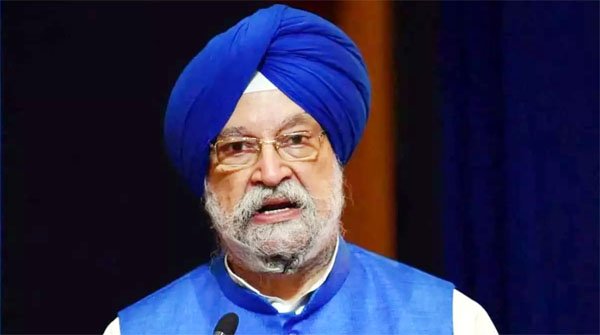
New Delhi, Mar 12 (UNI) Petroleum and Natural Gas Minister Hardeep Singh Puri said on Thursday that India’s energy supplies remain secure despite the ongoing disruption in global shipping through the Strait of Hormuz following the conflict involving Iran, Israel and the United States.
Stressing that this was not the moment for rumor-mongering or fake narratives, the minister said in Lok Sabha that India is navigating the most severe global energy disruption in recorded history. Puri said there is no shortage of petrol, diesel, and kerosene in the country, and assured that retail outlets across the country are stocked and supply chains for these products are functioning normally.
Speaking on concerns voiced by Members over the energy crisis, he said the refineries are operating at high capacity utilisation, adding that in several cases, they are exceeding 100 per cent.
“There is no shortage of petrol, diesel, kerosene, ATF, or fuel oil. The availability of petrol, diesel, aviation, turbine fuel, kerosene and fuel oil is fully assured,” he said.
He informed the House that non-Hormuz sourcing has risen to approximately 70 per cent of crude imports, up from 55 per cent before the conflict began.
”India’s sources grew to 40 countries as against 27 in 2006 and 2007. This structural diversification built through sustained policy over successive years has given us options that other nations find themselves without. The refineries are operating at high capacity utilisation,” he added.
Puri said the crisis has created an unprecedented global energy challenge but India has managed to maintain stable supplies of crude oil, natural gas and LPG through diversification and contingency planning.
“For the first time in recorded history, the Strait of Hormuz has been effectively closed to commercial shipping.”
The minister said that although India had no role in the conflict, it must deal with the global consequences. “Despite India having no role in causing the conflict, like many countries, India has to navigate through its consequences,” he said.
Highlighting the contrast with measures taken by other countries facing fuel shortages, Puri said several nations had already introduced emergency restrictions. “A country in our neighbourhood has shut all schools for two weeks, moved government offices to a four-day work week, ordered 50 per cent of public employees to work from home, cut fuel allowances for official vehicles by half, and taken 60 per cent of government vehicles off the road.”
“This country has experienced the largest single fuel price increase in its history, with petrol up approximately 20 per cent in a week.”
Another neighbouring country had also introduced emergency measures, he added. “Another neighbour has closed universities early and brought forward the Eid-al-Fitr holiday to save fuel. Countries in Southeast Asia also have had to take energy rationing and conservation measures.”
Puri, however, said India’s crude supply position remains stable. “India’s crude supply position is secure, and volumes secured exceed what Hormuz would have delivered,” he said.
He noted that earlier about 45 per cent of India’s crude imports transited through the Strait of Hormuz, but the government had successfully diversified supplies. “India has secured crude volumes that exceed what the disrupted Strait route would have delivered in the same period,” he said.
Refineries across the country are operating at high utilisation levels, he said.
“Refineries are operating at high capacity utilisation; in several cases, they are exceeding 100 per cent.”
Puri also outlined steps taken to manage natural gas supplies. “Natural gas supply has been managed through prioritised allocation, and the position is stable well beyond immediate need,” he said.
India currently produces around 90 million metric standard cubic metres per day (MMSCMD) of natural gas domestically, he said, while earlier around 30 MMSCMD was imported from Gulf sources affected by the crisis.
“The Natural Gas Control Order issued on 9 March 2026 established an immediate priority sequence,” he said.
“Domestic piped gas to homes and CNG for vehicles receive 100 per cent supply with no cuts.”
Industrial consumers will receive up to 80 per cent of their previous six-month average, while fertiliser plants will receive up to 70 per cent to safeguard the agricultural supply chain, he added.
“I am pleased to inform the House that the shortfall has been substantially offset through alternative procurement,” he said.
“Large LNG cargoes are arriving on an almost daily basis through alternative supply routes, and India has sufficient gas production and supply arrangements to sustain this position even in the event of a prolonged conflict.”
On LPG supplies, Puri said the government has diversified sourcing beyond Gulf countries. “India was previously importing approximately 60 per cent of its LPG requirements from Gulf countries such as Qatar, UAE, Saudi Arabia and Kuwait,” he said.
“Procurement has now been actively diversified, with cargoes being secured from the United States, Norway, Canada, Algeria and Russia.”
The Minister said, ”The world has not faced a moment like this in modern energy history. India’s crude supply position is secure, and the volume secured exceeds what the Hormuz would have delivered. Before the crisis, approximately 45 per cent of India’s crude imports transited through the Strait of Hormuz route. Thanks to the Prime Minister’s outstanding diplomatic outreach and goodwill, India has secured crude volumes that exceed what the disrupted state of Hormuz could have delivered in the same period.”
He reiterated that the domestic supply is fully protected, and the delivery cycle remains unchanged. The standard time from booking to delivery for domestic LPG cylinders remains 2.5 days, unchanged from the pre-crisis norm. Hospitals and educational institutions have been placed on uninterrupted priority supply, and their access to LPG is fully assured regardless of broader demand conditions.
He said refinery production of LPG has also been stepped up. “In the last five days, LPG production has been increased by 28 per cent through refinery directives, and further procurement is actively underway.”
Puri stressed that the government’s top priority is ensuring uninterrupted cooking gas supply to households. “Modi Government’s foremost priority is that the kitchens of India’s 33 plus crore families, especially the poor and the underprivileged, do not face any shortage,” he said.
“The standard time from booking to delivery for domestic LPG cylinders remains 2.5 days, unchanged from pre-crisis norms.”
He said panic booking by consumers in some areas was driven by anxiety rather than actual shortages. “The rush-booking pressure in some localities reflects a demand distortion, not a production or supply failure.”
Concluding his statement, the minister urged citizens to avoid spreading rumours about shortages. “This is not the moment for rumour-mongering or fake narratives,” he said.
“India is navigating the most severe global energy disruption in recorded history. Crude supply is flowing. Gas is prioritised for homes and farms. LPG production has been stepped up by 28 per cent.”
“Schools are open. Petrol is on the forecourt. Every citizen, regardless of political affiliation, has a stake in that.”