


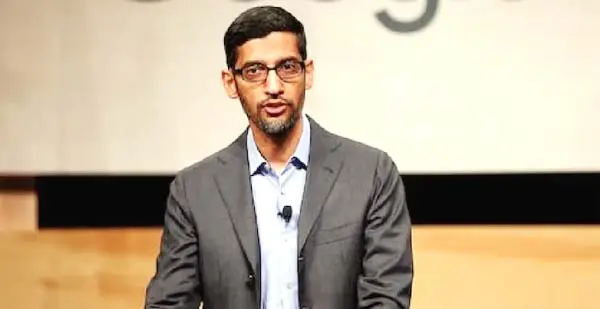
New Delhi, Feb 19 (UNI) Google and Alphabet CEO Sundar Pichai’s address at the Impact AI Summit drew the loudest applause as he announced a major investment in the southern port city of Visakhapatnam, known as Vizag, that would anchor a “full-stack AI hub” as part of Google’s $15 billion infrastructure investment in India.
“I remember it being a quiet and modest coastal city brimming with potential,” Pichai said of Vizag. “Now, Google is establishing a full-stack AI hub there as part of our USD 15 billion infrastructure investment in India. When finished, this hub will house gigawatt-scale compute and a new international subsea cable gateway, bringing jobs and cutting-edge AI to people and businesses across India. Sitting on the train, I never imagined Vizag becoming a global AI hub.”
Pichai said he is “struck by the pace of change” in India and praised the country’s growing role in the global AI ecosystem.
Pichai, a native of Chennai in Tamil Nadu, recalled how his father, Regunatha Pichai, told him he would be “more impressed” if driverless cars worked on India’s busy roads.
He praised the Indian government for sending AI-powered forecasts to millions of farmers last summer, noting that it was made possible in part by their NeuralGCM model.
Pichai also said that Google is building a vast network of subsea fiber-optic cables, including four new systems between the U.S. and India, as part of their America-India Connect initiative announced yesterday.
“AI will undeniably reshape the workforce, automating some roles, evolving others, and creating entirely new careers. Twenty years ago, the concept of a professional YouTube creator didn’t exist. Today, there are millions around the world,” he said.
Pichai described artificial intelligence as the defining technological leap of the era, warning, however, that its benefits are not inevitable.
“It is the biggest platform shift of our lifetimes. We are on the cusp of hyper-progress and new discoveries that can help emerging economies leapfrog legacy gaps. But that outcome is neither guaranteed nor automatic,” he said.
Pichai emphasized that AI represents a transformative shift in technology with the potential to accelerate progress across sectors and help emerging economies advance faster. “The product shows what’s possible when humanity dreams big, and no technology has me dreaming bigger than AI,” he said.
Explaining the reasons for optimism around AI, Pichai pointed to its role in advancing scientific discovery and improving lives globally.
The Google CEO highlighted AlphaFold, the AI system developed by Google DeepMind that solved the protein-structure prediction problem, as evidence of what the technology could achieve at scale.
“This breakthrough, which just won a Nobel Prize, compressed decades of research into a database that is now open to the world,” he noted.
The resulting database is now used by over three million researchers across 190 countries to develop malaria vaccines and combat antibiotic resistance, he added.
Pichai further said that AI is being used across the scientific ecosystem, from cataloging DNA disease markers to building AI agents that act as partners in scientific research. “We are asking similarly bold questions across the scientific stack. We must be equally bold in tackling problems in regions that have lacked access to technology,” he added.
“No technology has me dreaming bigger than AI,” Pichai said. “We must be equally bold in tackling problems in regions that have lacked access to technology.”
Prime Minister Narendra Modi joined Pichai, OpenAI CEO Sam Altman, Anthropic CEO Dario Amodei, Meta’s Chief AI Officer Alexandr Wang, and other global tech leaders for a group photograph at the summit, underscoring the event’s significance as the first major AI gathering hosted in the Global South.
The India AI Impact Summit runs through February 20 and is anchored around three themes, ‘People, Planet, and Progress’.
He highlighted tools like SynthID, used by journalists and citizen fact-checkers worldwide to verify the authenticity of content.