




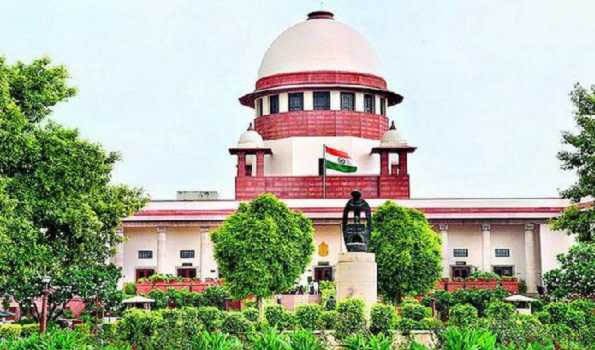
New Delhi, Nov 20 (UNI) In a significant constitutional pronouncement, the Supreme Court on Thursday held that State Governors cannot indefinitely sit on Bills passed by State Legislatures. However, the Court also made it clear that it cannot prescribe mandatory timelines for the President or Governors to grant or deny assent under Articles 200 and 201 of the Constitution.
However, it clarified that Governors cannot indefinitely sit on Bills. In cases of prolonged, unexplained inaction, courts may issue a limited mandamus directing them to decide within a reasonable time without examining the merits of the Bill.
The Court categorically ruled that the concept of courts declaring “deemed assent” in cases of delay is unconstitutional and violates the doctrine of separation of powers.
Answering a Presidential reference under Article 143, a Constitution Bench of Chief Justice of India BR Gavai, Justice Surya Kant, Justice Vikram Nath, Justice PS Narasimha and Justice AS Chandurkar stated that judicially imposed deadlines would be contrary to the “elasticity” envisaged in the constitutional scheme.
The reference was made in May, soon after the Supreme Court’s judgment in the Tamil Nadu Governor case, which had laid down timelines for constitutional authorities to act on Bills.
The Bench heard arguments over ten days and had reserved its opinion on September 11.
The key questions and the Supreme Court’s answers are: 1. Constitutional options before a Governor under Article 200?
The Governor may assent to the Bill, withhold assent (which must necessarily be accompanied by returning the Bill to the Assembly), or reserve the Bill for the President.
Withholding assent without returning the Bill is impermissible and violates federalism.
2. Is the Governor bound by the aid & advice of the Council of Ministers under Article 200?
The Governor ordinarily acts on aid and advice, but Article 200 confers limited constitutional discretion particularly in returning or reserving a Bill.
3. Is the Governor’s discretion justiciable?
Merits of the decision are not justiciable.
However, prolonged, unexplained inaction may invite a limited judicial direction to decide.
4. Does Article 361 bar judicial review?
The Governor enjoys personal immunity, but the office of the Governor remains subject to limited judicial scrutiny in cases of inaction.
5–7. Can courts impose timelines on the Governor/President under Articles 200/201? Is their discretion justiciable?
No.
Imposing timelines would violate constitutional separation of powers. “Deemed assent” is unconstitutional.
The President’s discretion under Article 201 is also not justiciable, and courts cannot prescribe timelines for the President either.
8. Must the President always seek Supreme Court advice under Article 143 when a Bill is reserved?
No. Seeking advice is not mandatory. It depends on the President’s subjective satisfaction.
9. Can courts review decisions of the Governor/President before a Bill becomes law?
No. Judicial review is permissible only after the Bill becomes law.
10. Can Article 142 be used to substitute Presidential/Gubernatorial decisions?
No.
11–14. Other queries
The Court reiterated that laws requiring assent to come into force, refused to extend Article 142 beyond its permissible limits, and declined to answer the question on Article 131 as irrelevant.
The Bench repeatedly clarified it was not sitting in appeal over the Tamil Nadu Governor judgment but only addressing constitutional questions raised by the President. Several States including Tamil Nadu, Kerala, West Bengal and Punjab opposed the maintainability of the reference, arguing that the issues had already been decided.
The Court questioned whether Governors could withhold Bills indefinitely, warning that such a practice could place democratically elected governments at the “whims of the Governor.”
Attorney General R. Venkataramani and Solicitor General Tushar Mehta opposed judicial timelines, arguing that courts cannot assume the functions of constitutional offices. They also rejected the idea of “deemed assent.”
Senior Advocates Kapil Sibal, Dr. AM Singhvi, KK Venugopal, Gopal Subramanium, and Arvind Datar argued in favour of judicially enforceable timelines to prevent constitutional paralysis caused by delayed assent.
Senior Advocates Harish Salve and Mahesh Jethmalani supported the Union’s stand against fixed timelines.