






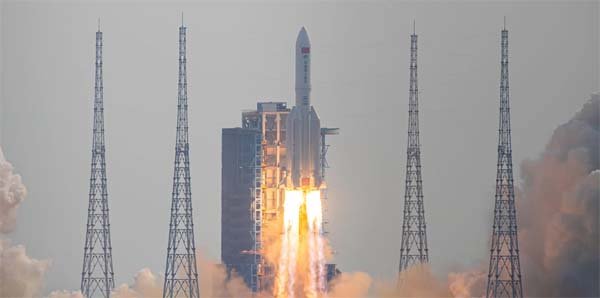
Chennai, Jan 10 (UNI) The Indian Space Research Organisation’s Polar Satellite Launch Vehicle, PSLV-C62, will carry a unique Spanish payload that is designed to re-enter Earth’s atmosphere shortly after launch. The mission is scheduled for January 12, 2026, at 10:17 am Indian Standard Time (IST) from Sriharikota.
Among the payloads is the Spanish KID (Kestrel Initial Technology Demonstrator), developed by Spanish space startup Orbital Paradigm. KID will be ejected into space at an altitude of about 504 km, roughly 108 minutes after PSLV liftoff, and is expected to reenter Earth’s atmosphere after that.
KID is a reentry capsule developed in just one year by a nine-member engineering team. According to Orbital Paradigm, it has three customers: ALATYR, Leibniz Universität Hannover, and one undisclosed client. The capsule will not be recovered, as it does not carry a parachute. Instead, it will transmit payload data before reentering the atmosphere.
The Kestrel system is intended as a reusable cargo capsule capable of carrying up to 120 kg of payload and remaining in orbit for as long as three months, with the long-term goal of routine space-to-Earth missions.
NewSpace India Ltd. (NSIL), the commercial arm of India’s Department of Space, said that about 18 minutes after liftoff, PSLV-C62 will place its primary payload, India’s EOS-N1 Earth observation satellite, along with 14 other satellites into orbit.
The rocket’s fourth stage will then restart, perform a de-boost maneuver, and enter a reentry trajectory.
Following KID’s separation, both the PSLV fourth stage and the KID capsule will reenter Earth’s atmosphere, with their impact expected in the South Pacific Ocean.
Another notable foreign payload on PSLV-C62 is Orbital Temple from Brazilian company AlltoSpace. This PocketQube satellite, weighing about 245 grams and measuring 50 × 58 × 64 mm, will be placed in a sun-synchronous orbit at an altitude of 525 km.
Orbital Temple stores the names of people sent to it during its operational lifetime and transmits a message reading: “Today, at this hour, the name you sent ascended, and there it remains.” More than 14,000 names have already been submitted ahead of the launch.
AlltoSpace is also flying four additional satellites on PSLV-C62, including Edusat, to demonstrate Internet of Things (IoT) sensors in Brazil; Uaisat, for agricultural data collection; Galaxy Explorer, for radiation measurement and IoT connectivity; and Aldebaran-1, aimed at assisting distressed fishing vessels along Brazil’s Maranhão coast.
The mission will further include Theos-2, an Earth observation satellite built by SSTL of the UK for Thailand, and Munal, a technology demonstration satellite from a Nepalese university.