






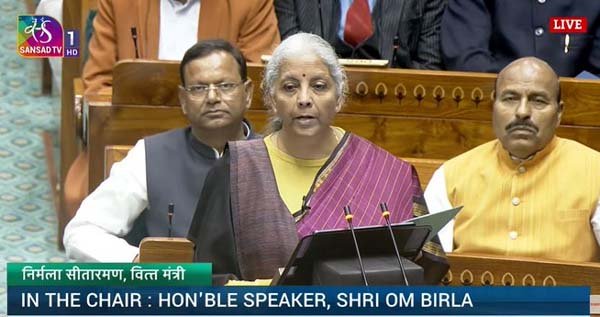
New Delhi, Feb 1 (UNI) Finance Minister Nirmala Sitharaman on Sunday announced the creation of a rare earth minerals corridor covering Tamil Nadu, Odisha, Andhra Pradesh and Kerala, underscoring the strategic importance of strengthening India’s critical minerals supply chain and building domestic capabilities in high-technology sectors.
Presenting the proposal during her ninth consecutive Budget speech in Parliament, Sitharaman said the corridor would focus on exploration, processing and value addition of rare earth elements, which are essential for electronics, renewable energy, electric mobility and defence manufacturing.
The announcement comes amid stepped-up efforts by India to strengthen its rare earth resources and build a complete domestic value chain to reduce dependence on imports.
The experts say that India’s growing demand for rare earth elements is closely linked to the rise of new technologies, noting their critical role in magnets used for electric vehicles, wind turbines and advanced manufacturing.
They also said that the import dependence has become increasingly difficult due to global supply constraints and export restrictions by major producing countries, highlighting the need to develop the entire value chain domestically.
In this context, the central government recently approved the Scheme to Promote Manufacturing of Sintered Rare Earth Permanent Magnets with a financial outlay of ₹7,280 crore. The scheme aims to establish 6,000 metric tonnes per annum of integrated rare earth permanent magnet manufacturing capacity in India, covering the full chain from rare earth oxides to finished magnets.
Officials said the initiative is intended to enhance self-reliance in a critical input for electric vehicles, renewable energy systems, electronics, aerospace and defence, and to position India as a key player in the global permanent magnet market. The scheme also aligns with national objectives such as Atmanirbhar Bharat, resilient supply chains for strategic sectors and the Net Zero 2070 vision.
Under the scheme, capacity will be distributed among up to five beneficiaries through a global competitive bidding process, with sales-linked incentives of ₹6,450 crore over five years and a capital subsidy of ₹750 crore to support the establishment of advanced manufacturing facilities. The programme will be implemented over seven years, including a two-year gestation period followed by five years of incentive-linked production.
India has a substantial base of rare earth resources, particularly monazite deposits across coastal and inland regions in states such as Andhra Pradesh, Odisha, Tamil Nadu and Kerala, which provide the raw material for downstream industries including permanent magnet manufacturing. However, domestic production of rare earth permanent magnets remains limited, with imports meeting a significant portion of demand.
Forward projections indicate that India’s consumption of rare earth permanent magnets is expected to double by 2030, driven by growth in electric mobility, renewable energy deployment, electronics manufacturing and strategic applications, officials said.
The proposed rare earth minerals corridor, along with the permanent magnet manufacturing scheme, is expected to complement the National Critical Minerals Mission and recent mining reforms, strengthening India’s end-to-end critical minerals value chain from exploration and mining to processing and advanced manufacturing.
Officials said these measures would attract investment, generate employment and position mineral-rich coastal states, particularly Tamil Nadu, Odisha, Andhra Pradesh and Kerala, as key hubs in India’s emerging critical minerals ecosystem.