






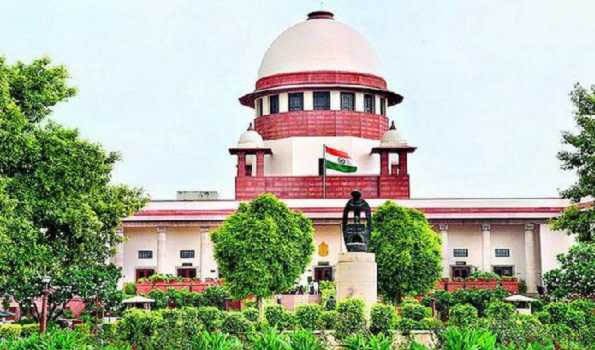
New Delhi, Oct 14 (UNI) The Supreme Court has upheld the Telangana High Court’s decision to quash criminal proceedings against Jerusalem Mathai in the 2015 cash-for-vote scam, finding no material evidence linking him to the alleged offence.
A bench comprising Chief Justice of India BR Gavai and Justice K. Vinod Chandran dismissed the special leave petitions (SLPs) filed by the Telangana government and then MLA Elvis Stephenson, observing that there was “nothing to connect A4 (Mathai) to the crime except a casual allegation.”
The court noted that no First Information Report (FIR) was registered under Section 154 of the Code of Criminal Procedure, 1973, on the written complaint initially made by Stephenson, and that the FIR eventually registered mentioned the police presence at the location of the alleged incident.
“Admittedly, A4 (Jerusalem Mathai) was not present when the alleged transaction took place. The allegations in the complaint are not in any way linked with the alleged higher offer made by another person. We find absolutely no reason to interfere with the High Court’s order,” the bench held.
The bench clarified that it was refraining from commenting on the May 31, 2015 incident, as those allegedly involved were not before the court. It added that the complaint only contained a vague reference to a phone call received by the complainant, without specifying the time or context of the alleged offer.
Rejecting the Telangana government’s contention that the High Court had conducted a “mini-trial,” the Supreme Court observed that while the High Court’s order was lengthy, it contained valid reasoning and did not warrant interference.
“For reasons only of brevity having not been employed, we cannot set aside an order which, though lengthy, cites justifiable grounds for quashing the proceedings. Brevity at times is a virtue, but often in legalese, it is faulted as levity,” the bench remarked.
The state had argued that a cognizable offence was made out based on the FIR, recorded evidence, and recovered bribe money, and hence, the High Court should not have quashed the case at a preliminary stage.
However, Mathai’s counsel contended that there was “absolutely no material” against him and that the allegations were “so improbable as to justify quashing.”
The Supreme Court found merit in the High Court’s reasoning, noting inconsistencies in the FIR and the complaint.
While the complaint was filed on May 28, 2015, the FIR was registered only on May 31, 2015, and entries in the general diary reflected a delay and discrepancy in the timing.
It was alleged that Mathai had offered Stephenson Rs 2 crore and a foreign trip to vote for a particular party candidate in the June 1, 2015, Legislative Council elections, while another individual allegedly made a higher offer of Rs 5 crore for the same purpose.
The court observed that there was no evidence linking these two alleged offers or establishing Mathai’s involvement.
The cash-for-vote case, which also names Telangana Chief Minister Revanth Reddy (then a TDP leader) as one of the accused, had drawn significant political attention.
The Supreme Court’s ruling effectively ends proceedings against Jerusalem Mathai in the case.