





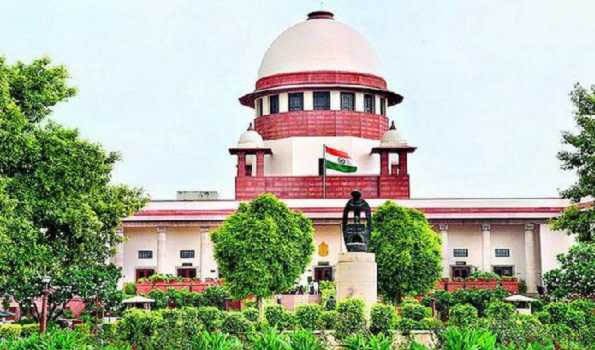
New Delhi, Sept 11 (UNI) The Supreme Court recently dismissed four appeals filed by Neeraj Kumar, former Commissioner of Police, Delhi, and Joint Director of the Central Bureau of Investigation (CBI), along with Vinod Pandey, former Assistant Commissioner of Police (ACP), Delhi Police.
The appeals challenged two judgments of the Delhi High Court delivered in June 2006 directing registration of FIRs against them. The High Court had directed that FIRs be registered against the two officers for allegedly fabricating and forging documents during an investigation against Ashok Kumar Aggarwal, a former IRS officer.
It was further found that they had unlawfully summoned Vijay Aggarwal, the younger brother of Ashok Aggarwal, in violation of court orders, and had harassed and detained him to pressure him into withdrawing a perjury complaint filed against Neeraj Kumar.
The High Court also initiated criminal contempt proceedings against both the officers. The Supreme Court upheld the High Court’s direction and modified the investigation procedure by directing that Delhi Police, instead of its Special Cell, complete the inquiry within three months through an officer of the rank of ACP or above.
A bench comprising Justice Pankaj Mithal and Justice Prasanna B. Varale, while passing the order, observed, “It is high time that sometimes those who investigate must also be investigated to keep alive the faith of the public at large in the system.”
“It is cardinal in law that justice must not only be done, but must also be seen to be done. The court rejected the appellants claims that the complaints did not disclose cognizable offences and that a preliminary inquiry by the CBI had absolved them of wrongdoing,” it said.
The bench noted that allegations of coercion, intimidation, fabrication of records, and wrongful seizure could not be dismissed and held that public servants cannot claim immunity when accused of knowingly preparing false records or abusing power.
The court also condoned the delay in approaching it, explaining that the appellants had pursued Letters Patent Appeals in the Delhi High Court, which were dismissed in 2019. It rejected impleading the CBI, saying that “it is the officers who are aggrieved in their personal capacity and not the institution to which they are on deputation.”
Citing precedents including Ramesh Kumari vs State (NCT of Delhi) (2006), Sakiri Vasu vs State of UP (2008), Lalita Kumari vs Government of Uttar Pradesh (2014), Pradeep Nirankarnath Sharma vs State of Gujarat (2025), and Anurag Bhatnagar vs State (NCT of Delhi) (2025), the court affirmed that FIR registration is mandatory when cognizable offences are prima facie made out, and preliminary inquiry cannot substitute statutory obligations.
The court concluded that the High Court’s findings were only prima facie and would not bind the investigating officer. It directed that custodial interrogation, if required, must be handled by an ACP-rank officer, and that protection against coercive steps would apply unless arrest was deemed necessary during investigation.