




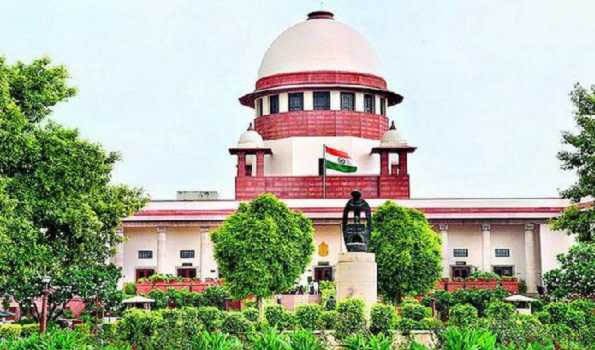
New Delhi, Feb 4 (UNI) The Supreme Court on Wednesday agreed to consider a plea seeking a probe by the Central Bureau of Investigation (CBI) and the Central Vigilance Commission (CVC) into the One Time Settlement (OTS) entered into between Asian Hotels (North) Pvt Ltd, Bank of Maharashtra (BoM) and Punjab National Bank (PNB).
A Bench comprising Chief Justice of India Justice Surya Kant, Justice Joymalya Bagchi and Justice Vipul Pancholi was hearing a challenge to a Delhi High Court judgment which had dismissed a writ petition seeking directions for an investigation into the OTS transactions.
The plea has been filed by NGO Infrastructure Watchdog, which alleges that the OTS arrived at between the banks and Asian Hotels to settle outstanding dues was contrary to existing law and banking norms.
Appearing for the petitioner, Advocate Prashant Bhushan submitted that the OTS violated the Reserve Bank of India (RBI) mandate, which requires stressed loans exceeding Rs 100 crore to be auctioned.
The plea states that during the COVID period, in 2021, all lenders agreed to a One Time Restructuring (OTR) of Asian Hotels’ outstanding loans at the borrower’s request.
As of September 1, 2020, the total outstanding loan amount was Rs 705 crore. At that time, the market value of the hotel property was assessed at Rs 2,600 crore by one valuer and Rs 2,651 crore by another.
However, when the OTS was finalised in 2024, the same valuer allegedly reduced the market value of the hotel property to Rs 970 crore, despite a significant rise in real estate prices in the Delhi NCR region.
The petitioner contended that this sharp reduction in valuation raised serious questions warranting an independent investigation.
Senior Advocates N. Venkataraman and Mukul Rohatgi, appearing for the respondent banks, opposed the plea. They informed the Court that Asian Hotels had attempted to auction its hotel building and assets on two occasions, but no buyers came forward.
Venkataraman further submitted that the banks had already recovered 116% of the loan amount, and that the petition amounted to seeking a “roving inquiry” into a concluded commercial transaction.
He informed the Bench that the total loan sanctioned was Rs 242.61 crore, the ledger balance at the time of OTS was Rs 226.54 crore, and the total amount recovered stood at Rs 414.6 crore.
Justice Joymalya Bagchi observed that the petitioners must also take into account that this was a commercial transaction in which the ledger value had already been recovered.
Senior Advocate Rohatgi added that the borrower’s account had been declared a Non-Performing Asset (NPA).
In response, the CJI remarked that once an account is declared NPA and the borrower’s assets are valued higher, banks would ordinarily opt for auction. The Bench was informed that the settlement was entered into in 2025.
Taking note of this, the CJI questioned why the hotel property was not auctioned at that stage, particularly when real estate values were rising post-COVID.
“Even a layman in Delhi can take judicial notice of the fact that from 2023 to 2025, real estate prices were rising.
“When you are entering into a settlement in January 2025, the value of a five-star hotel in Delhi is bound to be high,” the CJI observed.
He also recalled a recent case involving a hotel in Kerala where several bidders had come forward during the auction process, observing that a hotel property in Delhi would likely attract even more interest.
The Supreme Court issued notice to the union of India, Punjab National Bank, Bank of Maharashtra, and Asian Hotels (North) Pvt Ltd.
The matter has been listed for further hearing on March 18.
The Delhi High Court had earlier dismissed the petition on multiple grounds, holding that the plea was based on insufficient material. The petitioners had approached the court prematurely without waiting for responses to their complaints;
OTS decisions fall within the domain of commercial wisdom and are generally not amenable to judicial review; and mere allegations are insufficient to trigger a criminal investigation, relying on precedents including Dr Subramanian Swamy v. union of India, Kunga Nima Lepcha v. State of Sikkim, and State of Jharkhand v. Shiv Shankar Sharma.
The Supreme Court will now examine whether the circumstances of the case warrant interference and an independent probe.