






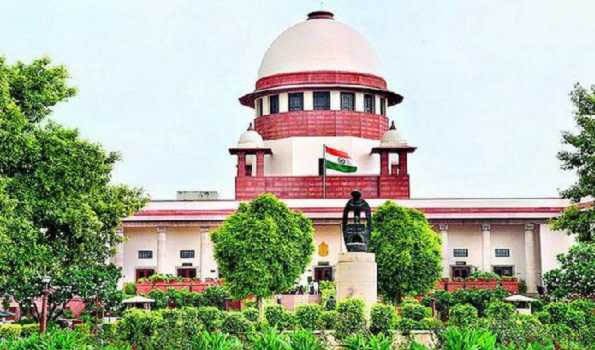
New Delhi, Sep 15 (UNI) The Supreme Court today stayed select provisions of the Waqf (Amendment) Act, 2025, while reserving other parts, holding that certain clauses could lead to arbitrary powers and violate the principle of separation of powers.
A bench comprising Chief Justice of India B.R. Gavai and Justice A.G. Masih passed the interim order while noting that the registration requirement under the Act will remain in force.
The Court stayed the following provisions: – Five-Year Practising Condition: Section 3(1)(r), which mandates that a person must be a practising Muslim for at least five years to create a Waqf, has been stayed.
The Court directed that this provision will not apply until state governments frame rules to determine the applicability of the requirement. The bench noted that without such a mechanism, the provision could result in an “arbitrary exercise of power”.
The court said the proviso to sub-section (2) of Section 3C, allowing government officers to decide whether a Waqf property encroaches upon government land, has also been stayed.
The Court observed that allowing an executive officer to adjudicate the rights of individuals would violate the separation of powers. It directed that no third-party rights shall be created against any parties until the matter is adjudicated by the Tribunal.
The provision allowing the nomination of non-Muslim members to Waqf Boards has not been stayed.
However, the Court recommended that, as far as possible, ex-officio members should be Muslims.
It further clarified that the Central Waqf Council should include no more than four non-Muslim members, while State Waqf Boards should have no more than three non-Muslim members.
The Court did not interfere with the provision mandating registration, stating that it was already present in earlier enactments of 1995 and 2013. However, it extended the timeline for registration, with further details to be shared once the full judgement is uploaded.
The petitions challenging the constitutionality of the amendments were heard over three days, and the judgement had been reserved on May 22.
The amendments, passed by the Parliament earlier this year, were opposed by several political parties and organisations, including AIMIM MP Asaduddin Owaisi, Delhi AAP MLA Amanatullah Khan, Jamiat Ulema-i-Hind, Samastha Kerala Jamiatul Ulema, TMC MP Mahua Moitra, IUML, All India Muslim Personal Law Board, RJD MP Manoj Kumar Jha, and SP MP Zia Ur Rehman, as well as CPI and DMK, among others.
Intervention applications were filed by five BJP-led states: Assam, Rajasthan, Chhattisgarh, Uttarakhand, Haryana, and Maharashtra, supporting the legislation. The State of Kerala has also intervened in support of the amendments.
Common challenges raised in the petitions include removal of the ‘waqf by user’ provision, inclusion of non-Muslim members in Waqf Boards, the precondition of five years of practising Islam, the government’s adjudication in encroachment disputes, application of the Limitation Act to Waqf matters, invalidating Waqfs over ASI-protected monuments, restrictions on creating Waqfs in scheduled areas, limiting women’s representation, diluting waqf-alal-aulad rights, renaming the Act as the “Unified Waqf Management, Empowerment, Efficiency and Development Act”, and providing appeal mechanisms against Tribunal orders.
The case continues to raise significant questions regarding religious endowments, minority rights, and administrative authority.