



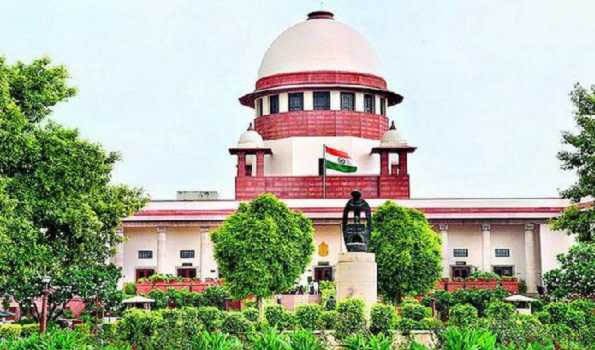
New Delhi, Jan 27 (UNI) The Supreme Court on Tuesday sought a response from the State of Uttar Pradesh on the question of repugnancy between provisions of the Uttar Pradesh Gangsters and Anti-Social Activities (Prevention) Act, 1986 and Section 111 (organised crime) of the Bharatiya Nyaya Sanhita, 2023 (BNS).
A bench comprising Justice J.B. Pardiwala and Justice K.V. Viswanathan was hearing a batch of writ petitions filed by several persons accused under the UP Gangster Act. When the matter was taken up on January 22, senior advocates Amit Anand Tiwari, Siddhartha Dave, Vinay Navare, Amit Kumar and Sanjai Kumar Pathak raised the issue of constitutional repugnancy between the State legislation and the newly enacted Central law
The petitions challenge Sections 3 (penalty), 12 (precedence of trial by Special Courts), 14 (attachment of property), 15 (release of property), 16 (inquiry into the character of acquisition of property) and 17 (orders after inquiry) of the UP Gangster Act. Certain provisions of the Uttar Pradesh Gangsters and Anti-Social Activities (Prevention) Rules, 2021, including Rules 16(3), 22, 35, 37(3) and 40, have also been assailed.
In the alternative, the petitioners have contended that these provisions violate Articles 14, 19, 21 and 300-A of the Constitution.
Senior advocate Amit Anand Tiwari submitted that Section 111 of the BNS and the UP Gangster Act occupy the same legislative field and are in direct and irreconcilable conflict. He argued that Parliament, by enacting Section 111, intended to create a comprehensive and exhaustive code governing organised crime and group-based criminal activity, thereby implicitly replacing State enactments such as the UP Gangster Act.
In support of his submissions, Tiwari relied on the Supreme Court’s decision in Forum for People’s Collective Efforts (FPCE) v. State of West Bengal (2021), where the Court struck down the West Bengal Housing Industry Regulation Act, 2017 on the ground of repugnancy with the Real Estate (Regulation and Development) Act, 2016.
The judgment, he pointed out, laid down three tests to determine repugnancy: whether there is a direct conflict between the two laws; whether Parliament intended to enact an exhaustive code on the subject matter; and whether both laws occupy the same field. Senior advocate Siddhartha Dave also highlighted the conflict between the State law and the BNS, placing reliance on the first test of direct inconsistency as enunciated in the Forum for People’s case.
Responding to the submissions, Additional Solicitor General K.M. Nataraj, appearing along with advocate Ruchira Goel for the State of Uttar Pradesh, submitted that the issue of repugnancy requires detailed examination and sought time to study the legal position. The Bench granted the State three weeks to file its response, specifically addressing the tests for repugnancy laid down in Forum for People’s Collective Efforts.
The Court also took note that a separate Bench of the Supreme Court last year had adopted guidelines framed by the Uttar Pradesh government pursuant to the Court’s observations in Gorakh Nath Mishra v. State of Uttar Pradesh in the SHUATS matter, where concerns were raised regarding the alleged misuse of the UP Gangster Act.


