






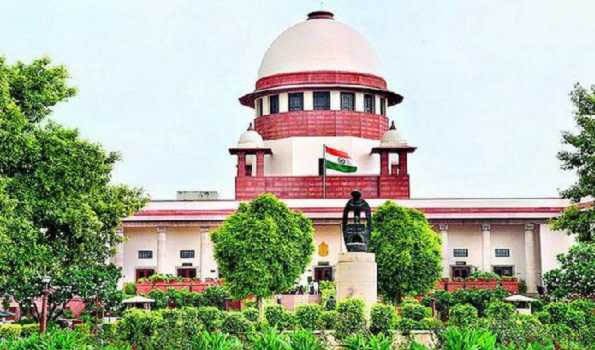
New Delhi, Nov 10 (UNI) The Supreme Court on Monday issued notice to the Central government on a public interest litigation (PIL) seeking the implementation of the women’s reservation law, which mandates one-third reservation for women in the Lok Sabha, State legislative assemblies, and the Delhi Legislative Assembly.
A Bench comprising Justice B V Nagarathna and Justice R Mahadevan, while issuing notice, clarified that the judiciary has a limited scope to intervene in policy implementation but is seeking the Central government’s response before proceeding further.
“The Preamble speaks of political and social equality. Who is the largest minority in this country? It is women, almost 48 per cent. This is about the political equality of women,” Justice Nagarathna said.
The PIL has been filed by Congress leader Dr. Jaya Thakur, who has urged the Court to direct the immediate enforcement of the Women’s Reservation Act, without waiting for a fresh delimitation exercise, which is currently a precondition built into the law.
Representing the petitioner, Senior Advocate Shobha Gupta submitted that even after 75 years of independence, women continue to struggle for proportional representation in law-making bodies.
“It is unfortunate that we have to approach the court for representation. They only need to reserve one-third of the seats. They have already agreed to the principle of reservation based on data,” Gupta argued.
The Bench clarified that the judiciary has a limited scope to intervene in policy implementation. “Enforcement of law is for the executive. We cannot issue a mandamus at this stage. Issue notice to the respondents. Let the union be served,” the Court said.
The Women’s Reservation Bill was passed by the Lok Sabha on September 20, 2023, and by the Rajya Sabha on September 21, 2023, before receiving Presidential assent on September 28, 2023.
The law inserted Article 334A into the Constitution, providing for one-third reservation for women. However, Article 334A stipulates that the reservation will come into force only after a delimitation process is carried out. This delimitation is to be based on the first census conducted after the constitutional amendment, meaning that implementation may be delayed by several years.
Dr. Thakur’s petition challenges this stipulation and seeks to strike down the words requiring reservation to take effect only “after an exercise of delimitation is undertaken…” as void ab initio. The petitioner argues that such a delay defeats the very objective of ensuring women’s adequate political participation.
The plea was initially filed in 2023 seeking implementation before the 2024 general elections, but it has since been re-filed in 2025. Today marked its first open-court hearing before the present Bench.
The matter will now proceed after the Central government files its response.