




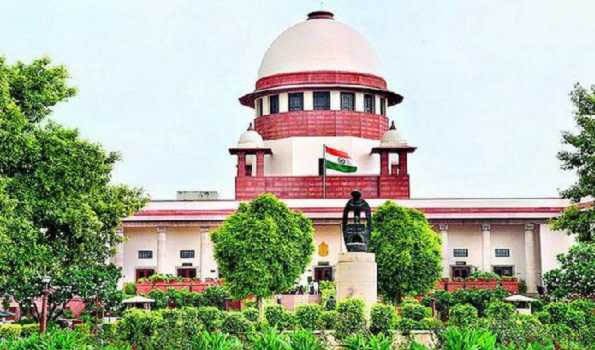
New Delhi, Dec 9 (UNI) The Supreme Court today questioned how persons who have applied for citizenship under the Citizenship Amendment Act (CAA), 2019, could be provisionally included in electoral rolls before they are granted citizenship.
A Bench comprising Chief Justice of India Surya Kant and Justice Joymalya Bagchi was hearing a petition filed by Aatmadeep, an NGO, seeking directions to include migrants from Bangladesh claimed to be eligible for citizenship under the CAA in the voters’ list after the ongoing Special Intensive Revision (SIR) in West Bengal.
Senior Advocate Karuna Nundy, appearing for the NGO, argued that thousands of refugees’ CAA applications had remained unprocessed. She contended that citizenship rights should accrue from the date of application, and the SIR process would “knock them out” of the electoral rolls before their applications are processed.
However, the Bench pushed back, asking how the Court could intervene when the applicants’ citizenship status was yet to be confirmed by the competent authority.
CJI Kant remarked, “You are not yet conferred citizenship. The amended law may give you the right to apply for citizenship, but each claim has to be determined, whether you belong to the specified minority, from the specified countries, and whether you are within India. Unless these claims are determined, you cannot put the cart before the horse.”
Justice Bagchi added, “First you acquire your citizenship, then entry into the electoral rolls comes.”
Bench noted that the NGO cannot seek voter enrollment before the status is decided. The Court clarified that the petitioner was an NGO and that no individual applicant had directly approached the Court, observing that it could only facilitate the determination of citizenship claims, not bypass the statutory process.
CJI Kant stated, “We can only facilitate the determination of your status; nothing more.”
Nundy urged the Court to set a timeline for deciding the pending CAA applications, relying on the Court’s earlier direction in Basudev Datta v. State of West Bengal, where a six-month limit was set for police verification in government appointments. She sought a similar deadline, proposing that applications received to date be decided by February 2026.
The Bench, however, declined, saying, “We will not be able to,” CJI Kant said.
Senior Advocate Rakesh Dwivedi, appearing for the Election Commission of India, clarified that the ECI has no role in determining citizenship.
“We don’t have a role to play in citizenship. The decision on CAA applications must be taken by the union of India,” he submitted.
After hearing the submissions, the Court issued notice to the union of India through the Attorney General. The petitioner was directed to serve a copy of the petition on the Solicitor General of India.
The matter will be taken up again next week.