




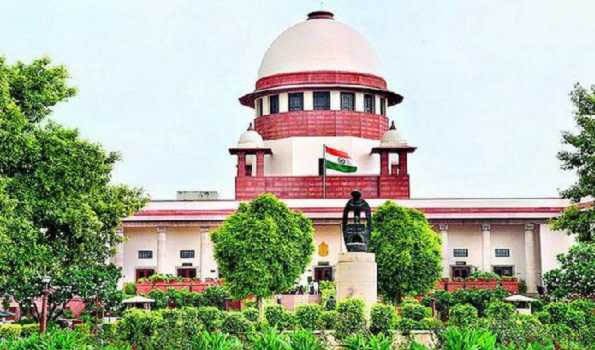
New Delhi, Jan 7 (UNI) The Supreme Court on Wednesday expressed serious concern over the increasing number of dog bite incidents across the country and strongly criticised municipal authorities and local bodies for failing to effectively implement the Animal Birth Control (ABC) Rules.
A three-judge Bench comprising Justices Vikram Nath, Sandeep Mehta and N.V. Anjaria was hearing detailed arguments in a suo motu case initiated by the Court on the issue of stray dogs and other animals in public places. The hearing in the matter will continue on Thursday.
“We are conscious that these things are happening. Children, adults are getting bitten, people are dying,” the Bench observed, underlining the gravity of the situation. The Court further noted that in the last 20 days, there had been two animal-related road accidents involving judges, one of whom continues to suffer from serious spinal injuries. “It’s a very serious issue,” the Bench said.
The issue of stray dogs had attracted nationwide attention last year after a Bench of Justices J.B. Pardiwala and R. Mahadevan directed Delhi municipal authorities to round up and shelter stray dogs, triggering protests from animal rights groups. That order was later modified by the present three-judge Bench, which mandated vaccination and release of sterilised dogs instead of permanent sheltering.
In November 2025, the Supreme Court had directed State governments and the National Highways Authority of India (NHAI) to ensure the removal of stray animals from highways across the country. The Court had also ordered that government and private educational and health institutions be fenced within eight weeks to prevent stray dog bites.
The Court had clarified that stray dogs picked up from such institutional areas should not be released back at the same location, noting that doing so would defeat the purpose of its directions.
Amicus curiae Gaurav Agarwal informed the Court that the NHAI has prepared a Standard Operating Procedure (SOP) to implement the Court’s directions. He stated that around 1,400 km of highway stretches had been identified as vulnerable, adding that after detection, the NHAI had indicated that State governments would have to take further action.
The Bench remarked that the NHAI could itself take steps to cordon off or fence roads where required. Agarwal further submitted that significant infrastructural development was needed to create shelters for cattle and stray dogs. He also informed the Court that, as per the Animal Welfare Board (AWB), male dogs should be prioritised for sterilisation to curb future reproduction, and that ABC centres face manpower shortages.
While affidavits were sought from all States, Agarwal informed the Bench that major States such as Madhya Pradesh, Uttar Pradesh, Tamil Nadu, Karnataka and Punjab are yet to file compliance affidavits. Senior Advocate Kapil Sibal, appearing for an animal rights litigant, submitted that the response to the issue must reflect a responsible and humane society. He emphasised the globally accepted CSVR model, Capture, Sterilise, Vaccinate and Release, stating that it had significantly reduced dog populations in certain regions.
He cautioned against housing vaccinated and unvaccinated dogs together, warning that it could increase the spread of rabies. When Sibal stated that he had never been bitten during visits to religious places, the Court remarked, “You are lucky. People are being bitten, children are being bitten.” The Bench also observed that the presence of animals on roads was leading to serious accidents. “It’s not just biting. Roads have to be clear and cleaned of dogs,” the Court said, rejecting the contention that dogs remain only within compounds.
Sibal argued that indiscriminate removal of dogs would create a territorial vacuum, leading to further problems. He also highlighted the economic burden of feeding dogs and claimed that incidents of dog bites had increased in certain areas following removal drives. Senior Advocate K.K. Venugopal, appearing for NALSAR Hyderabad, presented data on the scale of infrastructure required to shelter stray dogs. He submitted that India has over 15 lakh educational institutions and that, on an average estimate, more than 77,000 shelters would be required nationwide.
Venugopal further pointed out that the ABC Rules mandate that sterilised dogs be returned to the place from where they were picked up, and urged the Court to constitute an expert committee to examine the issue comprehensively. Senior Advocate Colin Gonsalves argued against mass removal of dogs, warning of “drastic and irreversible consequences” if stray dogs were confined to kennels. He stressed that vaccinated dogs, when released back, provide a protective shield even to unvaccinated dogs.
Senior Advocate Anand Grover submitted that several educational institutions had successfully managed stray dogs by allowing sterilised and vaccinated dogs to remain within their territories under structured supervision, resulting in negligible aggression. Solicitor General Tushar Mehta submitted that in gated communities, Residential Welfare Associations (RWAs) should decide, through a democratic process, whether stray animals should be allowed within their premises.
He argued that individual preferences must be balanced against collective safety and convenience, stating that animal welfare concerns cannot override the rights of residents who feel unsafe. Senior Advocate C.U. Singh and several other counsel also advanced submissions. A petitioner-in-person, appearing via video conferencing, placed on record photographs allegedly showing a senior citizen who was fatally injured by stray dogs. The matter will be taken up for further hearing on Thursday.