






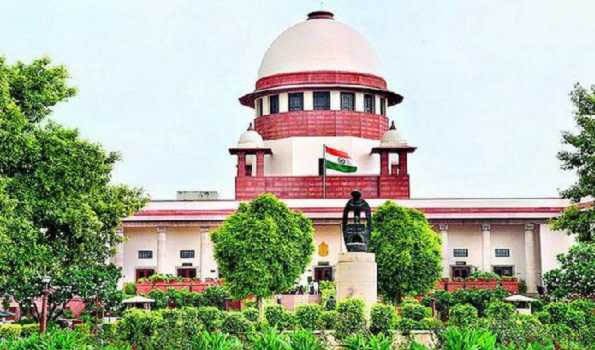
New Delhi, Jan 8 (UNI) The Supreme Court on Thursday continued hearing its suo motu proceedings on the stray dog menace, expanding the scope of deliberations to include ecological concerns after flagging the impact of feral dogs on rare wildlife in Ladakh.
A Bench comprising Justices Vikram Nath, Sandeep Mehta and N.V. Anjaria heard extensive submissions from senior advocates representing animal welfare organisations, victims of dog attacks, municipal bodies and other intervenors on issues relating to public safety, compliance with earlier directions, and implementation of the Animal Birth Control (ABC) Rules.
The Bench directed counsel to study a newspaper report dated December 29 highlighting incidents of feral dogs hunting rare species in Ladakh, indicating that environmental and wildlife considerations would also guide the Court’s future directions. The matter has been listed for further hearing on January 9.
Amicus Curiae Gaurav Agarwal informed the Court that four remaining states, flagged during the previous hearing, had filed their compliance affidavits overnight.
With this, sixteen states have filed compliance affidavits, while seven states are yet to do so. He sought one additional day to place a consolidated tabular chart of compliances on record.
Senior Advocate C.U. Singh submitted that four major states had formally objected to the Standard Operating Procedure (SOP) issued by the Animal Welfare Board of India (AWBI).
He cautioned against abrupt removal of dogs, arguing that it could disturb ecological balance by leading to a surge in rodent populations, which are carriers of diseases.
Justice Sandeep Mehta, in a lighter vein, remarked that encouraging cats could help control rodents, but clarified that the Court had never directed the removal of all dogs and that any action must strictly conform to the ABC Rules.
Singh stressed that sterilisation followed by re-release in the same area was the only model with proven success. He warned that mass sheltering in overcrowded facilities could increase the spread of diseases and argued that repeated non-compliance by states should not become a ground to dilute or discard the ABC Rules.
Senior Advocate Krishnan Venugopal, appearing for an animal rights expert, highlighted the magnitude of the issue and estimated that the proposed approach would cost nearly Rs 26,800 crore, requiring construction of more than 91,000 shelters across the country.
He pointed out the absence of any dedicated budgetary allocation for implementation of the Rules and suggested the creation of a single nodal agency, district-level infrastructure, trained manpower and the use of Corporate Social Responsibility (CSR) funds.
He also criticised the AWBI SOP for allegedly diluting safety standards, including reduction in fence heights and permitting untrained personnel to capture dogs.
Senior Advocate Dhruv Mehta argued that the absence of a nationwide census was a fundamental flaw in the current framework, noting that the last dog census was conducted in 2009. He submitted that capturing dogs without assessing shelter capacity violated the ABC Rules and risked mixing infected animals with healthy ones.
He urged the Court to keep its earlier directions in abeyance until reliable data and adequate infrastructure were put in place.
Senior Advocate Gopal Sankaranarayanan said that there was a need for a census and identification exercise before any removal of dogs, describing the situation as one of “complete non-compliance” by states.
He also raised concerns over a previous direction requiring animal lovers and NGOs to deposit money before being heard, contending that it created a barrier to access to justice.
Justice Vikram Nath remarked that without such a measure, the Court would need a pandal to accommodate all intervenors.
Several senior advocates, including Vinay Navare and Nakul Diwan, reiterated that the ABC Rules were not under challenge and that re-release remained the norm under the statutory framework.
They suggested scaling up successful models such as those implemented in Lucknow and at IIT Delhi, strengthening the role of local bodies and exploring technological solutions like micro-chipping.
Counsel appearing for victims and citizen groups highlighted recurring dog bite incidents, contending that aggressive dogs should not be automatically re-released and that residential complexes deserved protection akin to institutional premises.
They argued that public access to homes and streets under Article 21 could not be curtailed by the creation of feeding zones.
On the animal welfare side, Senior Advocates Shyam Diwan and Siddharth Luthra pressed for the constitution of an expert committee and cautioned against judicial directions that went beyond the statutory scheme. They warned that prolonged detention of dogs could amount to cruelty and emphasised that existing statutory bodies must be allowed to function.
Intervenors from institutions such as Delhi University and IIT Delhi placed data on record demonstrating that sustained sterilisation, vaccination and monitoring programmes had significantly reduced aggression and rabies without relocating dogs. They submitted that institution-led initiatives, supported by local administration, could provide immediate relief while long-term infrastructure was being developed.
Concluding the hearing, the Bench acknowledged the complexity and seriousness of the issue, stressing the need to balance human safety, animal welfare and ecological considerations.
The matter will be taken up for further hearing tomorrow, January 9.