



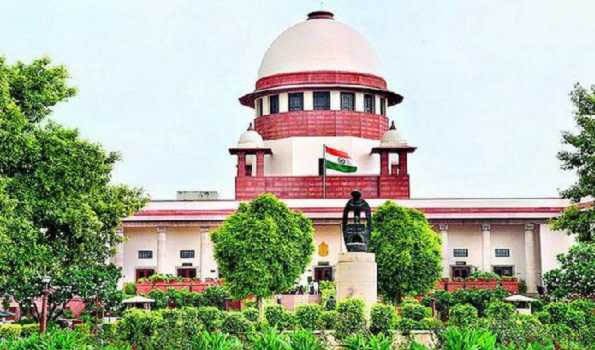
New Delhi, Jan 19 (UNI) The Supreme Court on Monday heard a batch of pleas challenging the Delhi School Education (Transparency in Fixation and Regulation of Fees) Act, 2025, with the Bench expressing concern over the proposed retrospective implementation of the fee regulation mechanism for the ongoing academic year.
A Bench comprising Justice P.S. Narasimha and Justice Alok Aradhe was hearing the matter.
Senior Advocate Mukul Rohatgi, appearing for the petitioners, contended that the 2025 Act is repugnant to the Delhi School Education Act, 1973, a Parliamentary enactment, and therefore unconstitutional.
He submitted that though the 2025 Act is projected as supplementary legislation, it in fact conflicts with the central law.
Rohatgi also challenged a circular dated December 24, 2025, issued under the Act, arguing that even assuming the validity of the legislation, the circular was contrary to the Act itself.
He submitted that the Act ought not to have been implemented for the current academic year.
Taking the Court through the provisions, Rohatgi submitted that under the Act, school managements cannot fix fees but can only propose them. He pointed out that the proviso states that for the academic year 2025–26, the fee being charged shall be deemed to be the proposed fee.
He further submitted that upon constitution of the fee regulation committee, school managements are required to submit details of the proposed fee for the next block of three years by July 31 of the current academic year, a timeline which has already elapsed.
Justice Narasimha sought clarification on the contents of the impugned circular.
In response, Rohatgi submitted that the circular mandates retrospective fixation of fees even for the academic year which commenced on April 1, 2025, which, according to him, was impermissible.
During the hearing, Justice Narasimha observed that while the Court was broadly in favour of the objective of the legislation, a hurried implementation could result in committees not being properly constituted.
Additional Solicitor General S.V. Raju, appearing for the government, submitted that the issue had been elaborately argued before the High Court and that timelines had been extended at the request of stakeholders. He contended that the present exercise was a one-time measure applicable only for the academic year 2025–26.
The Bench, however, questioned the rationale behind advancing the formation of committees to January when the Act contemplated such formation by July.
Justice Narasimha remarked that the implementation mechanism appeared “completely convoluted,” noting that the academic year had already begun and the statutory timelines had passed.
Highlighting the potential impact on educational institutions, Justice Narasimha observed that while the Act is a welfare legislation aimed at addressing phenomenally high school fees, hurried and retrospective implementation could render institutions unviable. He cautioned that excessive anxiety in implementation could undermine the very purpose of the legislation.
The Bench indicated that it would interfere as little as possible and suggested that the constitution of the committees alone may be sufficient at this stage, while expressing serious reservations about retrospective fee fixation for the academic year 2025–26.
When Rohatgi submitted that he did not want the Court’s observations to be construed as granting a seal of approval to the committees, Justice Narasimha responded that the Court’s primary concern was with the aspect of fee fixation.
The Bench asked the parties to reflect on the issue and come back, reiterating that while the Act is well-intentioned, it must be implemented in a proper and workable manner.


