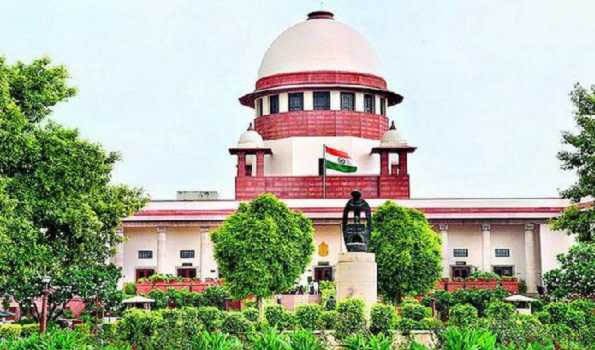






New Delhi, Jan 13 (UNI) The Supreme Court on Tuesday directed the Chairman of Coal India Limited to create a supernumerary post for a woman who was denied employment despite qualifying for an interview in 2016, solely due to her multiple disabilities.
A Bench comprising Justice J.B. Pardiwala and Justice K.V. Viswanathan passed the order in favour of the appellant, Sujata Bora, while clarifying that the decision was made in the peculiar facts of the case and should not be treated as a precedent.
The Court noted that the vacancy advertisement issued by Coal India did not mention multiple disabilities. As a result, Sujata Bora had applied under the visually handicapped category.
Although she qualified for the interview and appeared for document verification and medical examination, she was denied an appointment after it was found that she suffered from multiple disabilities.
Setting aside the Calcutta High Court’s order dated July 3, 2024, the Supreme Court held that the appellant was denied employment through no fault of her own.
The Court directed that she be given a suitable desk job with a separate computer and keyboard, in accordance with universal design standards under the Rights of Persons with Disabilities Act, 2016.
She is to be posted at North Eastern Coal Fields, Coal India Limited, at Margherita in Tinsukia district of Assam.
Reading out the order, Justice Pardiwala referred to international human rights instruments and principles laid down by the International Labour Organisation, emphasising the importance of disability inclusion.
The Court observed that inclusion of persons with disabilities is an essential part of social responsibility and sustainable governance, and that disability inclusion should be seen not merely as a legal obligation but as a strategic advantage.
In its operative directions, the Court said the appellant’s disability exceeded the benchmark disability requirement and that she was denied employment only because the recruitment notification failed to provide for multiple disabilities.
Keeping these circumstances in mind, the Court ordered the creation of a supernumerary post and expressed confidence that the Chairman of Coal India would provide her a position suited to her abilities.
The Bench clarified that the order was passed keeping in view Articles 14, 21, and 41 of the Constitution, and also in exercise of the Supreme Court’s powers under Article 142.
The Court also appreciated the assistance of Advocate Vivek Narayan Sharma, appearing for Coal India Limited, for helping resolve the matter, and thanked the doctors who examined the appellant.
After pronouncing the judgment, Justice Pardiwala wished Sujata Bora well and encouraged her to make the country proud.
The case arose after Sujata Bora applied for the post of Management Trainee (Personnel and HR) as a reserved candidate in the visually handicapped category.
Though she cleared the interview stage, medical examination revealed that she had 60 percent low vision in both eyes along with residual partial hemiparesis.
She was denied relief by the Calcutta High Court, following which she approached the Supreme Court.
During the proceedings, Coal India argued that the appellant did not meet the benchmark disability requirement under the RPwD Act.
The Supreme Court then directed AIIMS, New Delhi, to constitute a medical board to assess whether she suffered from benchmark and multiple disabilities. Based on the overall facts and findings, the Court granted relief to the appellant.
SC directs Coal India to create a supernumerary post for woman with multiple disabilities