




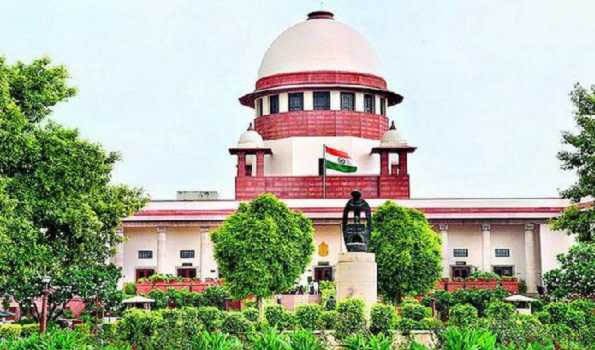
New Delhi, Jan 27 (UNI) The Supreme Court on Tuesday observed that development and environmental protection must progress together, while declining to interfere with tree felling undertaken for the second phase of a riverfront development project in Ahmedabad.
A Bench comprising Chief Justice of India Surya Kant, Justice R. Mahadevan and Justice Joymalya Bagchi was hearing a plea filed by a resident of Hansol village in Ahmedabad, raising concerns over large-scale tree felling for the project.
Refusing to grant relief, the Court noted that the trees which were felled were largely of wild growth and that their regeneration would not require significant effort. “Development and environment have to go hand in hand,” the Chief Justice observed. The plea before the Supreme Court challenged a December 2025 order of the National Green Tribunal (NGT), Pune, which had declined to interfere with the tree felling.
The NGT had recorded that the trees proposed to be cut were Gando Baval (commonly referred to as mad trees), which are not a protected species, and that the land in question was non-forest land. The Tribunal had also rejected the claim that the area was ecologically sensitive. During the hearing, counsel for the petitioner contended that around 4,000 mature trees had been cut, amounting to the destruction of a forest that was said to be planted 50–60 years ago.
He submitted that alternatives were not explored and that the area supported wildlife such as Nilgai. Emphasising the ecological cost, counsel argued that mature trees cannot be replaced easily and that their felling was carried out by invoking a notification meant for farmers, without adherence to prescribed rules.
The Bench, however, observed that environmental loss caused in the course of development can be mitigated over time through afforestation. The Chief Justice remarked that such wild-growth trees regenerate easily and referred to successful afforestation initiatives undertaken in other parts of the country, including Rajasthan.
He also noted that the Court had before it the report of an expert body. The petitioner’s counsel persisted, alleging that the expert assessment was one-sided and that larger trees were, in fact, cut despite claims to the contrary.
The Bench, however, reiterated that some environmental impact is inevitable in development projects, particularly when infrastructure such as roads or helipads is required for emergency access.
While the petitioner argued that an airport was located nearby and that protected wildlife species were present in the area, the Bench maintained that it was not inclined to interfere, especially in view of the assurance of compensatory afforestation.
Observing that the area was not a notified forest and that the trees were of wild growth, the Chief Justice noted that the authorities had undertaken to carry out a double compensatory plantation. The Supreme Court proceeded to close the plea, directing the National Green Tribunal to constitute a committee to identify suitable land for carrying out compensatory plantation of trees.