


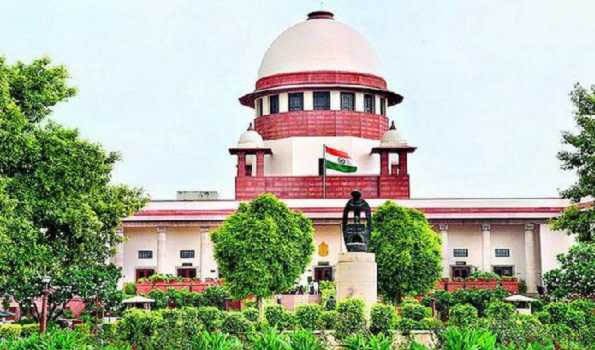
New Delhi, Feb 6 (UNI) The Supreme Court on Friday refused to entertain a writ petition filed by Prashant Kishor-led Jan Suraaj Party challenging the Bihar Assembly Elections, 2025 and seeking directions for fresh elections in the State.
When the Bench indicated its disinclination to entertain the matter, the petitioner sought permission to withdraw the petition with liberty to approach the High Court.
Granting such liberty, a Bench comprising Chief Justice of India Surya Kant and Justice Joymalya Bagchi dismissed the petition as withdrawn.
The writ petition under Article 32 of the Constitution challenged, inter alia, the addition of beneficiaries and direct cash transfers of Rs 10,000 to women voters under the Mukhyamantri Mahila Rojgar Yojana during the subsistence of the Model Code of Conduct.
The petitioner alleged that such transfers amounted to corrupt practices and vitiated the level playing field in the elections.
At the outset, Justice Joymalya Bagchi queried under which clause of Section 100 of the Representation of the People Act, 1951 an entire Assembly election could be set aside.
Senior Advocate Chander Uday Singh, appearing for the petitioner, submitted that the Supreme Court was already examining the issue of “freebies” in other pending matters and contended that large-scale cash transfers in a fiscally stressed State without budgetary support disrupted free and fair elections.
The Chief Justice observed that the writ petition was a “composite election petition” seeking an “omnibus” order to set aside the entire election.
The Court noted that allegations of corrupt practices must be specific to individual candidates and constituencies, and that the appropriate remedy was to file election petitions under the Representation of the People Act.
While the petitioner argued that the cash transfer scheme had been announced just ahead of the elections and extended to over 1.56 crore women without adequate scrutiny, the CJI pointed out that the writ petition contained no specific prayer challenging the scheme itself, but instead sought to invalidate the entire election.
In the course of the hearing, the Chief Justice remarked that electoral rejection could not be converted into a judicial forum for political revival, observing that if people reject a party, approaching courts for popularity was not the appropriate course.
The Bench clarified that although the issue of “freebies” was being examined seriously in other pending matters, it would not do so at the instance of a party that had lost the elections and was seeking to set aside the entire electoral process.
The Court advised the petitioner to approach the High Court, noting that the issue raised was not of a pan-India nature.
The petition had sought declarations that the addition of beneficiaries and payments made during the Model Code of Conduct violated Articles 14, 21, 112, 202 and 324 of the Constitution, and prayed for directions to the Election Commission of India to take action under Article 324 of the Constitution and Section 123 of the Representation of the People Act.
It also sought directions for fresh Assembly elections in Bihar and for the framing of comprehensive guidelines on freebies and Direct Benefit Transfer schemes in line with the decision in S. Subramaniam Balaji v. State of Tamil Nadu.
With these observations, the Supreme Court dismissed the petition as withdrawn, granting liberty to the petitioner to pursue remedies before the appropriate High Court.