





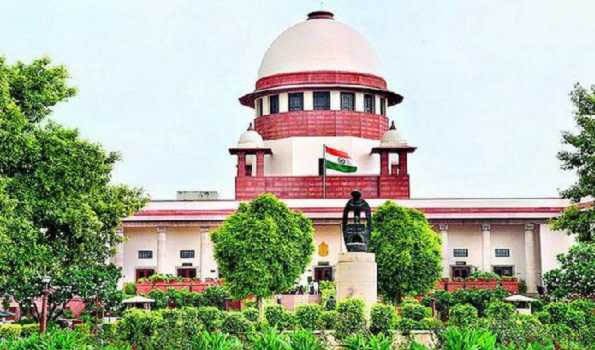
New Delhi, Nov 20 (UNI) The Supreme Court today refused to impose a blanket ban on construction activities in Delhi and the National Capital Region amid worsening air quality, observing that environmental concerns must be balanced with developmental needs.
A bench led by Chief Justice of India B.R. Gavai, while hearing a matter related to air pollution in the national capital, remarked, “We are no experts.”
Emphasising that protection of the environment must go hand-in-hand with development, the bench said it was not inclined to issue sweeping directions in the backdrop of Delhi’s deteriorating Air Quality Index (AQI).
Expressing serious concern over the recurring pollution crisis, the Court underlined that temporary solutions were insufficient. It urged the union Government to devise long-term measures, noting that the primary responsibility to manage Delhi’s pollution rests with the Centre.
The bench also highlighted that a complete construction ban could have severe socio-economic repercussions, affecting lakhs dependent on the sector for their livelihood.
Responding to the Court’s queries, the Centre submitted that the challenge lies in determining how much pollution can be reduced without infringing on human rights.
Senior Advocate Gopal Sankaranarayanan urged the Court to adopt stricter air quality norms akin to California, citing high mortality due to lung cancer.
However, Additional Solicitor General Aishwarya Bhati argued that pollution benchmarks used in developed nations cannot be directly applied to developing economies like India, which are still undergoing industrialisation.
The bench reiterated that it was “not an expert body” and declined to pass directions mandating California-style, stringent standards.
The Court was informed that the union Environment Minister met Delhi-NCR environment ministers on November 11 to discuss emergency measures, with another meeting expected soon.
Allegations were also raised that water sprinkling was conducted near pollution monitoring stations to distort AQI readings.
The amicus curiae pointed out that several monitoring devices cap out at an AQI of 999, making them incapable of recording further deterioration in air quality.
Directing the Centre to file details on the monitoring devices, including their type, efficiency, and compliance with global standards by November 19, the bench also sought an affidavit from the Delhi government on the issue.