




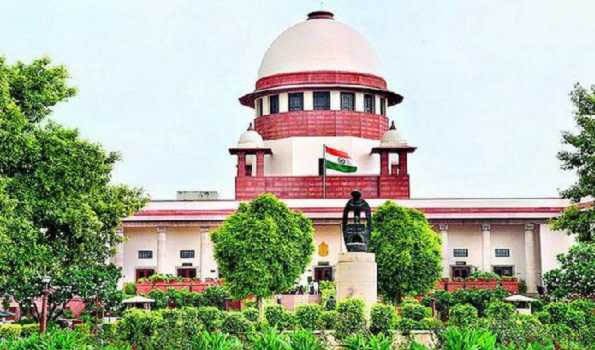
New Delhi, Oct 7 (UNI) Retaining that the right to use footpaths and footways is an essential facet of the fundamental right to life under Article 21 of the Constitution, the Supreme Court today issued a set of guidelines for enhancing pedestrian and road safety across the country.
With the judgment, the apex court has set a six-month deadline for all states and union Territories to complete the rule-making process, thereby laying the foundation for a nationwide framework to ensure pedestrian-friendly, safe, and accessible roads across India.
The apex court directions also cover the regulation of footpaths, the wearing of helmets, the prevention of wrong-lane driving, and the use of unauthorised hooters and lights on vehicles.
A bench comprising Justice JB Pardiwala and Justice KV Viswanathan passed the order in a long-standing writ petition concerning pedestrian safety and safe road infrastructure.
The court directed all states and union Territories to formulate rules within six months under Section 138(1A) of the Motor Vehicles Act, 1988, to regulate the activities and access of non-mechanically propelled vehicles and pedestrians on public roads and national highways.
The Bench directed that States and UTs also frame and notify rules under Section 210D of the Act to set design, construction, and maintenance standards for all roads other than national highways.
The bench, while elaborating the scope of its order, referred to various statutory provisions having a direct bearing on pedestrian safety including Sections 138 (power of state government to make rules), 198A (failure to comply with road design and construction standards), 210C (power of Central government to make rules), and 210D (power of state government to make rules) of the Motor Vehicles Act.
Justice Pardiwala, while pronouncing the order, noted that the court had taken into account the Central government’s exercise of powers under Section 210C, under which the Motor Vehicle Rules, 2020, were framed.
The judgment also referred to the “Guidelines for Pedestrian Safety (Second Revision, June 2022)” issued by the Indian Roads Congress (IRC), and reaffirmed that properly maintained footpaths are a judicially recognised right under the landmark ruling in Olga Tellis v. Bombay Municipal Corporation and subsequent judgments.
The court’s directions also addressed specific safety concerns such as proper maintenance of pavements and pedestrian crossings; Mandatory use of helmets; Curbing wrong-lane driving and unsafe overtaking; and regulating unauthorised use of white LED lights, red and blue beacons, and vehicle hooters.
During the pronouncement, Justice Pardiwala remarked that while the court has provided an extensive framework for pedestrian safety, “all now depends on how effectively the guidelines are implemented.”
In earlier proceedings of this PIL, the Supreme Court had already held that the right to use footpaths and footways is an essential facet of the fundamental right to life under Article 21 of the Constitution.
In May 2024, it directed states and UTs to ensure that footpaths are accessible and usable by persons with disabilities and to adopt uniform design standards for pedestrian pathways.