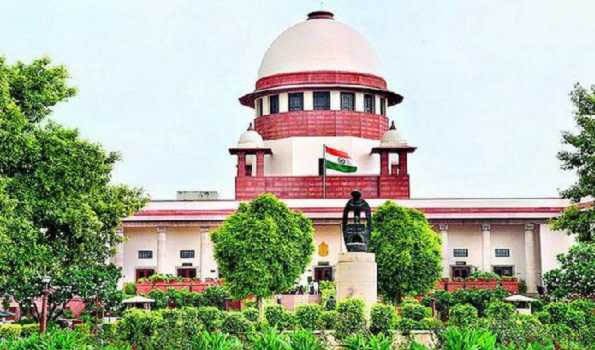






New Delhi, Dec 19 (UNI) The Supreme Court has asked the Election Commission of India (ECI) to consider, in a “sympathetic” manner, representations seeking extension of time for the ongoing Special Intensive Revision (SIR) of electoral rolls in Uttar Pradesh and Kerala, keeping in view the prevailing ground realities.
A bench comprising Chief Justice of India Surya Kant and Justice Joymalya Bagchi was hearing a batch of petitions challenging the legality and manner of the SIR exercise being carried out in several states.
During the hearing, senior advocate Kapil Sibal, appearing for one of the petitioners, expressed concern over large-scale deletions from the electoral rolls, particularly in Uttar Pradesh. He informed the court that nearly 25 lakh names had reportedly been removed from the rolls in the state.
Pointing to irregularities in the process, Sibal submitted that in several instances, the names of husbands continued to appear on the rolls while those of their wives were missing. He also highlighted that the deadline for completing the revision exercise was fast approaching.
As per the schedule notified by the Election Commission, the SIR in Uttar Pradesh is slated to conclude on December 3.
Opposing the plea, senior advocate Rakesh Dwivedi, appearing for the Election Commission, contended that both the conduct of the SIR exercise and the timelines prescribed fell squarely within the exclusive domain of the constitutional authority.
He argued that judicial interference was unwarranted, particularly as the time for the exercise had already been extended once.
Another counsel appearing in the matter questioned the urgency behind the revision exercise, pointing out that the Uttar Pradesh Assembly elections are due only in 2027.
It was submitted that despite the considerable time available, the Election Commission was not providing adequate opportunity to the voters and officials to complete the revision process in a fair and orderly manner.
Taking note of the submissions, the bench refrained from issuing any mandatory directions, but requested the Election Commission to consider representations seeking extension of time in a sympathetic manner, keeping ground realities in mind.
The court also deferred the final hearing in the batch of petitions to January 6, clarifying that on the next date, senior advocate Rakesh Dwivedi would commence final arguments on behalf of the Election Commission.
The petitions challenge the SIR process on the ground that it may lead to disenfranchisement of genuine voters. Earlier, on December 11, the court had heard detailed submissions from senior advocate Raju Ramachandran, appearing for the petitioners.
Ramachandran had criticised the approach adopted by the Election Commission, contending that the poll body cannot assume the role of a “suspicious neighbour” or act like a “policeman” viewing voters with inherent distrust.
He had argued that the Election Commission’s constitutional mandate is to facilitate and protect the right to vote, not to undermine it, and that directing booth-level officers to approach voters with suspicion amounts to reversing the presumption in favour of inclusion in electoral rolls.
During the earlier hearing, the bench had also examined whether the Election Commission’s powers extend to conducting inquisitorial inquiries in matters of doubtful citizenship.
SC asks ECI to consider extension of electoral roll revision in UP and Kerala “sympathetically”