




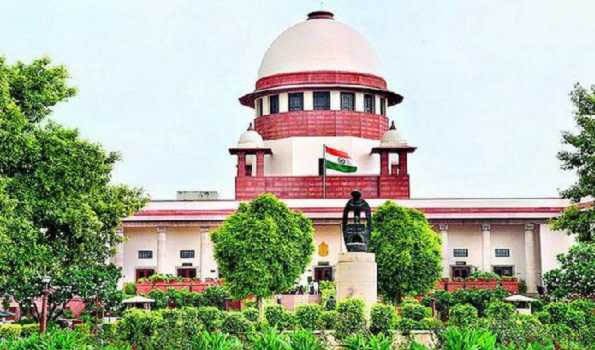
New Delhi, Oct 16 (UNI) The Supreme Court of India today permitted the withdrawal of a contempt petition filed against West Bengal Chief Minister Mamata Banerjee for her alleged remarks on the Court’s recent judgment invalidating the appointment of 23,123 teaching and non-teaching staff recruited through the State Level Selection Test (SLST)-2016 in West Bengal.
A Bench headed by Chief Justice of India B.R. Gavai, hearing the matter, was informed by the petitioner’s counsel that instructions had been received to withdraw the contempt plea. The Bench accordingly allowed the withdrawal.
In an earlier hearing held in July, a Bench comprising CJI Gavai and Justice K. Vinod Chandran had cautioned against politicising the issue when Senior Advocate Maninder Singh informed the Court that the petitioner had sought the Attorney General’s consent to initiate contempt proceedings. “Are you sure you will get consent? We should dismiss it right now. Don’t politicise such issues,” the Bench had observed.
It may be recalled that in August 2025, the Supreme Court dismissed a batch of review petitions challenging its landmark April 3, 2025 judgment that had quashed the entire West Bengal School Service Commission (SSC) recruitment process under the SLST-2016, citing pervasive irregularities and fraud.
A Bench of Justice Sanjay Kumar and Justice Satish Chandra Sharma had ruled that the review pleas were essentially an attempt to seek a rehearing on merits, despite all legal and factual issues having already been thoroughly examined in the earlier verdict. The Court underscored that the April judgment was delivered after “extensive and exhaustive” hearings and upon considering multiple reports, including that of the Justice (Retd.) R.K. Bag Committee, findings of the Central Bureau of Investigation (CBI), and affidavits filed by the SSC and the West Bengal Board of Secondary Education. One of the most critical findings was the Commission’s failure to preserve original OMR sheets or their mirror copies, making verification impossible.
“The inevitable conclusion was that the entire selection process stood compromised owing to such illegalities,” the Court observed, holding that systemic corruption had tainted the entire recruitment drive. While acknowledging that the cancellation would cause “heartburn and anguish” to untainted candidates, the Court maintained that protecting the sanctity of public recruitment was paramount. “The purity of the selection process is of the highest priority and must remain pristine and free of infirmities,” the Bench stated. The Court also upheld adverse remarks against officials responsible for the recruitment scandal, holding them “wholly and solely accountable” for the widespread irregularities that impacted thousands of candidates. Rejecting the review pleas and requests for an open-court hearing, the Bench observed that “such petitions do not deserve to be entertained” since the issue had already been comprehensively adjudicated. The April 3, 2025 judgment had invalidated all appointments under SLST-2016 but extended limited relief to untainted candidates. The Court allowed those not found complicit in wrongdoing and previously employed in State departments or autonomous bodies to reapply to their earlier posts within three months.
Their applications, the Bench directed, must be processed expeditiously, allowing them to resume service if eligible. The Court further directed the West Bengal government to conduct a fresh recruitment exercise within three months to restore fairness and credibility to the system.
Before the matter reached the Supreme Court, a Division Bench of the Calcutta High Court comprising Justice Debangsu Basak and Justice Md. Shabbar Rashidi had cancelled the SLST-2016 process in its entirety. The Court had found the recruitment to be “shrouded in mystery” and “layered with such depth of illegality that it was difficult to fathom the quantum of wrongdoing.” The High Court also directed that candidates who submitted blank OMR sheets but still secured appointments must return all remuneration and benefits received, with 12% interest per annum, within four weeks.
The West Bengal government subsequently moved the Supreme Court, challenging this order and seeking interim relief, but the Apex Court upheld the High Court’s findings, citing evidence of manipulation, nepotism, and procedural violations.