





New Delhi, Jan 12 (UNI) The Supreme Court on Monday disposed of a writ petition filed by the Telangana government under Article 32 of the Constitution challenging the expansion of the Polavaram Multipurpose Irrigation Project, while granting liberty to the state to approach an appropriate forum to raise its grievances.
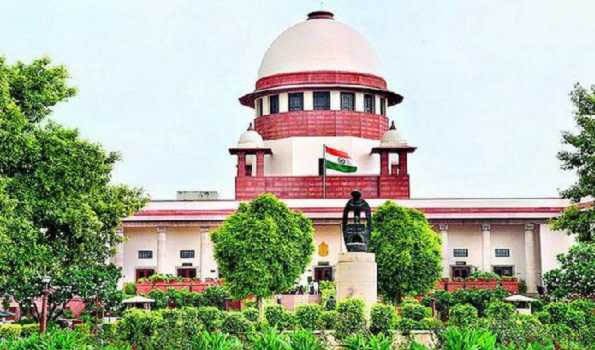
A bench comprising Chief Justice of India Justice Surya Kant and Justice Joymalya Bagchi was hearing the petition filed by Telangana against the union of India and the Andhra Pradesh government, alleging illegal diversion of Godavari river waters beyond the limits fixed under the Godavari Water Disputes Tribunal Award.
Senior advocate Abhishek Manu Singhvi, appearing for Telangana, argued that the matter involved serious constitutional and statutory violations. He submitted that there was a fixed allocation of Godavari waters under the tribunal award and that any diversion beyond the prescribed limits was illegal. He further contended that the expansion of the Polavaram project violated provisions of the relevant Godavari legislation.
Responding to the submissions, the Chief Justice observed that Telangana was essentially alleging a violation of statutory provisions and diversion of water beyond the tribunal’s award. “You are saying there is an allocation of distribution of water, and the attempt now is to go beyond that,” the CJI noted.
Justice Bagchi pointed out that other riparian states, namely Karnataka and Maharashtra, were also parties to the Godavari award but had not been impleaded in the petition. Following these observations, Singhvi sought permission to withdraw the petition, stating that Telangana would file a suit to pursue its remedies.
“I withdraw and will file the suit, which is almost ready. I cannot be remedy-less everywhere,” he said.
Accepting the request, the bench disposed of the petition, observing: “The writ petition is disposed of, being prima facie not maintainable, with liberty to the state petitioner to avail appropriate remedy and raise all the issues that have been taken up in the instant writ petition.”
The dispute relates to the Polavaram Multipurpose Irrigation Project in Andhra Pradesh, which has long been a point of contention between Telangana and Andhra Pradesh. Telangana has alleged that the expansion of the project would alter inter-state water allocations under the Godavari river system.
Earlier, on January 5, the court had indicated that the issue appeared to fall within the domain of an inter-state water dispute, which would be more appropriately addressed through a civil suit, rather than a writ petition under Article 32.
Telangana had contended that Andhra Pradesh was diverting excess flood waters beyond the permitted limit of 484 TMC, thereby affecting Telangana’s allocated share of 968 TMC.
The state claimed that such diversion would cause irreversible harm, particularly as Telangana is a relatively new state with several irrigation barrages still under construction. The Chief Justice, however, repeatedly raised concerns about the maintainability of the petition, remarking that “ultimately, at the end of the day, it is a water dispute.”
Singhvi argued that Telangana had approached the Supreme Court in an emergency situation, pointing to the findings of Central authorities, including the Central Water Commission (CWC) and the union Ministry of Jal Shakti, which had opined that flood waters, once diverted, could not be reversed.
He also referred to the union government’s decision on January 2, 2026, to constitute a high-powered committee to examine the issue.
The bench noted that once the Central government had formed a committee, Telangana should place its grievances before that body. The CJI observed that since Polavaram is a national project, no modification or diversion could be undertaken without prior approval of the Centre.
Concluding the hearing, the Court indicated that Telangana’s appropriate remedy would be to file a civil suit under Article 131 of the Constitution, impleading all concerned states, including Andhra Pradesh and Karnataka.