




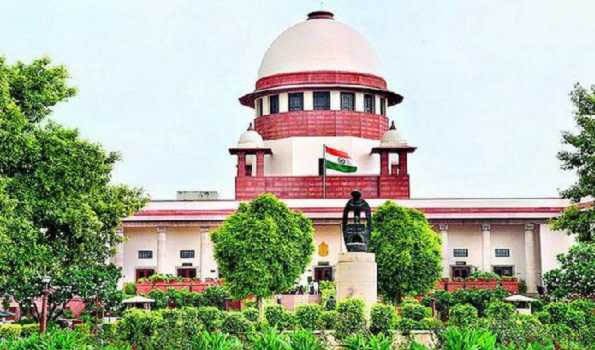
New Delhi, Feb 3 (UNI) The Supreme Court on Tuesday adjourned till February 10 the hearing on a plea filed by the Enforcement Directorate (ED) accusing the West Bengal government, Chief Minister Mamata Banerjee, former Director General of Police (DGP) Rajeev Kumar and other officials of obstructing the agency’s search operations at the office of political consultancy firm Indian Political Action Committee (I-PAC) in Kolkata.
A Bench comprising Justice Prashant Kumar Mishra and Justice Vipul M. Pancholi deferred the matter after Solicitor General Tushar Mehta, appearing for the ED, sought time to respond to the counter-affidavit filed by the State of West Bengal earlier in the day.
Mehta submitted that the ED had received the State’s response only on Tuesday and required time to examine it and file a rejoinder. Accepting the request, the Bench listed the matter for further hearing on February 10.
The ED’s petition arises from searches conducted on January 8 at the I-PAC office and at the residence of its co-founder, Pratik Jain, in connection with the coal scam money-laundering probe.
The agency alleged that its officials were obstructed during the operation and that the Chief Minister, accompanied by senior party leaders, reached the premises and confronted ED officers.
The ED further alleged that certain files were taken away during the raid, which, according to it, impeded the investigation and had an intimidating effect on its officers.
In its Article 32 petition before the Supreme Court, the ED had sought directions to register FIRs against the Chief Minister, the former DGP, and the Kolkata Police Commissioner.
It has also sought an independent inquiry by the Central Bureau of Investigation (CBI), contending that a neutral central agency is necessary in view of the alleged interference by the state executive.
Earlier, the Supreme Court had stayed three FIRs registered by the West Bengal Police against ED officials in connection with the searches, observing that the case raised serious questions about alleged interference by state agencies in a central investigation.
The Court had also issued notice to the Chief Minister and senior police officials, granting them time to file their counter-affidavits.
In an interim order passed earlier, the top court had directed the preservation of CCTV footage and other digital records from the searched premises and surrounding areas, noting that the matter prima facie involved a “serious issue” concerning the obstruction of central investigations.
The Court had cautioned that leaving such issues unresolved could lead to “lawlessness” in one or more states.
During earlier hearings, the Solicitor General had described the episode as one where “mobocracy replaces democracy,” alleging intimidation of ED officials.
Opposing the ED’s plea, Senior Advocate Abhishek Manu Singhvi, appearing for the West Bengal government, questioned the maintainability of the petition. In its counter-affidavit, the State contended that the ED, being a statutory authority, does not possess fundamental rights and therefore lacks locus to invoke the Supreme Court’s writ jurisdiction under Article 32.
The State also alleged violation of the right to privacy under Article 21, challenged the ED’s authority to conduct what it termed omnibus search and seizure operations, and claimed that no effective prior notice was given before the I-PAC search.
It further alleged violation of privileged communications and objected to what it described as parallel proceedings before the Calcutta High Court and the Supreme Court.
The State has also accused the ED of “forum shopping”, arguing that similar issues arising out of the same incident are already pending before the Calcutta High Court.
It may be noted that before approaching the Supreme Court, the ED had moved the High Court seeking protection and appropriate directions.
On January 14, the High Court disposed of a petition filed by the Trinamool Congress, recording the ED’s statement that it had not seized any material from the I-PAC office or its director.
The Supreme Court will now take up the matter for further consideration on February 10.