





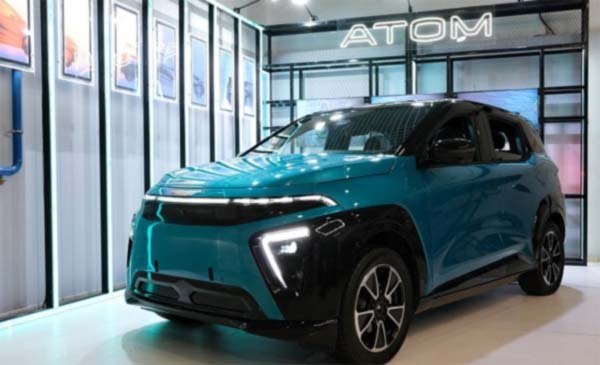
Chennai, Oct 7 (UNI) A car with advanced automobile technology is old news. Now, a car with atomic technologies will soon be plying on Russian roads.
And aptly, it is named Atom.
No, Atom is not powered by any nuclear reactors. But its key components, like electric drives, motors, batteries, and others, are developed by Russia’s integrated atomic power major, Rosatom State Corporation.
The Atom car is expected to go into mass production in Russia soon at the Moskvich factory in Moscow.
Addressing international and domestic media at the recently concluded World Atomic Week held in Moscow — commemorating the 80th anniversary of atomic power in Russia — Kirill Komarov, First Deputy Director General – Director for Development and International Business at Rosatom, said that like China, Russia will also catch on to the electric transport trend.
“I will not even mention the trend towards the development of electric transport. We see this primarily in China. Anyone who comes to Beijing or Shanghai today will see that about 40–50 per cent of all cars on the road already have green licence plates, meaning they are hybrids or electric vehicles,” Komarov said.
“I am confident that this trend will come to our country — to Russia. Sooner or later, it will spread throughout the world. Electric vehicles need electricity from somewhere,” he added.
And Rosatom expects that electricity to come largely from atomic power plants.
Komarov said Atom cars will enter serial production soon.
“More importantly, we are implementing two very ambitious projects to build two factories producing energy storage systems. Together, once operational, they will be capable of meeting the energy storage needs of 100,000 electric vehicles per year. Naturally, this will not only cover electric vehicles but also meet energy storage needs for the power sector,” Komarov said.
It is said that the car’s battery has a range of about 500 km on a single charge.
Like in the case of nuclear power systems, in electric vehicles too, Rosatom is building an end-to-end production chain — from lithium mining to the production of electric drives, electronic components, and more.
Given Rosatom’s plans to expand its non-nuclear business in India — where it is discussing a 50:50 joint venture for 3D printing equipment — and India’s focus on electric mobility, it may only be a matter of time before Rosatom pitches for business in India.