





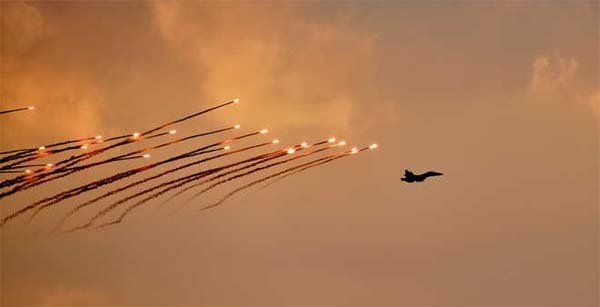
New Delhi, Feb 28 (UNI) In a first, the Indian Air Force transformed Exercise Vayushakti 2026 into a simulated live combat theatre, executing the drill along a defined operational storyline.
Seamlessly blending precision offensive air strikes, layered air defence operations, special forces missions and humanitarian assistance tasks, the exercise, conducted at Pokhran Field Firing Range, Jaisalmer, accentuated the IAF’s evolution into a fully integrated, multi-domain force.
President Droupadi Murmu attended the Fire Power Demonstration as the Chief Guest, accompanied by Governor of Rajasthan Haribhau Kisanrao Bagde, Defence Minister Rajnath Singh, Minister of Civil Aviation Kinjarapu Ram Mohan Naidu, and others.
The exercise showcased IAF’s capability to execute complex, integrated air operations within a dynamic and realistic battlefield environment. Earlier in the day, the President also undertook a sortie in the indigenously developed LCH Prachand, reflecting India’s growing self-reliance in defence manufacturing.
The exercise commenced with National Song and National Anthem, accompanied by a ceremonial flypast of Chetak helicopters carrying the national flag, Air Force Ensign and Operation Sindoor Flag. This was followed by a precisely timed sonic boom by a Rafale fighter, setting the stage for high-intensity combat missions.
Over 130 aircraft participated in a day and night exercise, including Rafale, Su-30 MKI, Mirage-2000, MiG-29, Jaguar, Hawk, Mi-17, C-130J, C-295, C-17, the indigenous Advanced Light Helicopter (ALH) Dhruv and Light Combat Helicopter (LCH) Prachand. Fighter aircraft executed precision strikes on simulated enemy targets using advanced air-to-ground weapons, including precision-guided munitions and long-range strike capabilities, underscoring the IAF’s ability to deliver decisive firepower with accuracy.
Air defence capabilities were demonstrated through coordinated engagements involving airborne platforms and ground based systems such as Akash and Spyder missile systems, supported by Army air defence assets, like L-70 and M-777, reflecting seamless jointmanship between air and ground forces.
Special operations and humanitarian assistance missions formed a key component of the exercise. As dusk fell, Garud Special Forces, along with Para SF elements, were inserted by Mi-17 helicopters to conduct simulated urban intervention and hostage rescue operations. This was followed by assault landings and evacuation by C-130 and C-295 aircraft from Advanced Landing Ground, reaffirming IAF’s critical role in rapid response and casualty evacuation.
The night phase of exercise showcased integrated air defence and air-landed operations, followed by precision night strikes by multiple fighter platforms, demonstrating IAF’s capability to dominate the battlespace round-the-clock. The exercise concluded with a symbolic ceasefire fly-past by a C-17 aircraft, followed by a drone display celebrating the IAF’s legacy and achievements.