





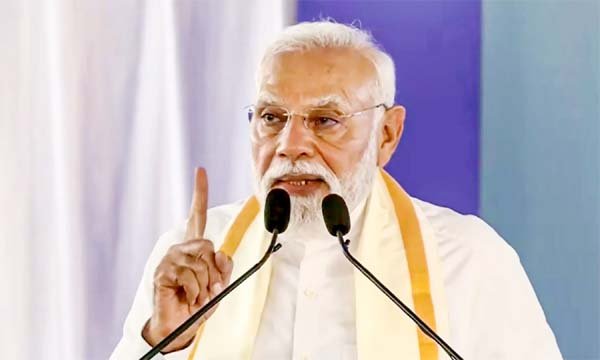
New Delhi, Mar 12 (UNI) Prime Minister Narendra Modi will embark on a two-day visit to Assam and West Bengal beginning March 13, during which he will inaugurate, dedicate to the nation and lay the foundation stones for a wide range of infrastructure and development projects collectively worth more than Rs 66,000 crore.
According to an official statement, the Prime Minister will participate in programmes across Kokrajhar, Guwahati and Silchar in Assam on March 13 and 14, before travelling to Kolkata in West Bengal later on March 14.
The projects span sectors including road infrastructure, railways, ports and shipping, energy, waterways, tourism and agriculture.
During his visit to Assam, Modi will launch development initiatives worth over Rs 47,800 crore.
At Kokrajhar on March 13, the Prime Minister will perform the Bhoomi Poojan of Assam Mala 3.0, a major road infrastructure initiative worth more than Rs 3,200 crore aimed at constructing over 900 kilometres of roads across the state to strengthen inter-state connectivity and improve links between national highways and rural roads.
He will also perform Bhoomi Poojan for six road infrastructure projects in the Bodoland Territorial Council region, including four flyovers and two bridges, with an investment of around Rs 1,100 crore.
These projects are expected to reduce congestion in Kokrajhar district while improving connectivity, tourism and access to agricultural markets, healthcare and rural services.
The Prime Minister will also lay the foundation stone of a Periodic Overhauling workshop at Bashbari in Kokrajhar district to strengthen railway maintenance infrastructure and create employment opportunities.
In addition, he will flag off three train services: the Kamakhya–Charlapalli Amrit Bharat Express linking the Northeast with southern India, the Guwahati–New Jalpaiguri Express connecting Assam with West Bengal, and the Narangi–Agartala Express improving connectivity between Assam and Tripura.
Later in the day in Guwahati, Modi will distribute land pattas to tea garden workers, marking what officials described as a significant step in providing homestead land rights to members of the tea garden community. The move is expected to enhance housing security and help beneficiaries gain better access to credit and government welfare schemes.
The Prime Minister will also release the 22nd instalment of the Pradhan Mantri Kisan Samman Nidhi scheme, transferring Rs 2,000 each to more than 9.3 crore farmers across the country through direct benefit transfer.
In the energy sector, he will dedicate to the nation the Kopili Hydro-Electric Project located in the Dima Hasao and West Karbi Anglong districts, built at a cost of more than Rs 2,300 crore. The project is expected to enhance clean energy generation and improve power reliability in the region. Modi will also dedicate the capacity enhancement project of the Numaligarh–Siliguri product pipeline operated by Oil India Limited and inaugurate Phase 1 of the North East Gas Grid, which connects Guwahati with Numaligarh, Gohpur and Itanagar, with a branch line extending to Dimapur.
He will also lay the foundation stone for Numaligarh Refinery Limited’s rail-fed POL terminal at Panchgram in Hailakandi district, part of efforts to strengthen energy infrastructure and support the refinery’s planned capacity expansion.
Several railway electrification projects will also be dedicated to the nation, including the Rangiya–Murkongselek rail line and the Chaparmukh–Dibrugarh rail line electrification projects, along with electrified rail sections between Badarpur–Silchar and Badarpur–Churaibari. These initiatives are aimed at enabling faster and more energy-efficient train operations across the Brahmaputra and Barak Valley regions.
The Prime Minister will further lay the foundation stone for the 194-kilometre Furkating–Tinsukia rail line doubling project, which will increase rail capacity and allow additional passenger and freight services.
In the waterways sector, Modi will lay the foundation stone for cruise terminals at Bishwanath Ghat in Biswanath district and Neamati in Jorhat district, and perform Bhoomi Poojan for a Regional Centre of Excellence at Bogibeel in Dibrugarh to serve as a maritime training and research hub for the Northeast.
Among the major urban mobility initiatives, the Prime Minister will lay the foundation stone for a ropeway connecting Kamakhya Railway Station to the revered Kamakhya Temple in Guwahati. The ropeway, to be developed using monocable detachable gondola technology, is expected to carry around 17,000 passengers daily and provide an environmentally friendly transport option for pilgrims.
He will also inaugurate the PM Ekta Mall in Guwahati, which is envisioned as a commercial and tourism hub showcasing handicrafts, handloom and GI-tagged products from Assam and other states under the One District One Product initiative.
On March 14 in Silchar, Modi will perform Bhoomi Poojan for the 166-kilometre Shillong–Silchar Corridor, the first access-controlled greenfield four-lane high-speed highway corridor in the Northeast. The project, estimated at about ₹22,860 crore, is expected to significantly improve connectivity between Meghalaya and Assam and reduce travel time between Guwahati and Silchar from about 8.5 hours to nearly five hours.
The Prime Minister will also perform Bhoomi Poojan for an elevated corridor on National Highway 306 in Silchar aimed at reducing congestion along one of the city’s busiest routes and improving connectivity with neighbouring states such as Mizoram, Tripura and Manipur.
In addition, he will lay the foundation stone for a new College of Agriculture at Patharkandi in Karimganj district to strengthen agricultural education and research in the Barak Valley region.
Later on March 14, Modi will travel to Kolkata in West Bengal where he will inaugurate and lay the foundation stone for development projects worth around Rs 18,680 crore.
A major portion of the investment will go toward road infrastructure projects covering more than 420 kilometres of national highways, worth around Rs wa16,990 crore. These include key stretches of National Highway 19 in West Bengal and Jharkhand and sections of National Highway 114 within the state.
The Prime Minister will also lay the foundation stone for five packages of the 231-kilometre Kharagpur–Moregram economic corridor on National Highway 116A, part of a larger economic connectivity route between Kharagpur and Siliguri. Officials said the corridor will reduce travel distance by nearly 120 kilometres and cut travel time by seven to eight hours while linking major national highways such as National Highway 16, NH-19, National Highway 14 and National Highway 12.
Additional projects include a 5.6-kilometre four-lane bypass at Dubrajpur and new bridges over the Kangshabati and Shilabati rivers on NH-14.
In the maritime sector, Modi will inaugurate the mechanisation project at Berth No. 2 of the Haldia Dock Complex and a rejuvenation project at Khidderpore Docks. He will also lay the foundation stone for several port infrastructure projects under the Syama Prasad Mookerjee Port, including the mechanisation of Berth No. 5 at Haldia, renovation of the bascule bridge at the Kolkata Dock System and riverbank protection works along the Hooghly River stretch from the Howrah Bridge pylon to Nimtala Ghat.
The Prime Minister will also flag off the Purulia–Anand Vihar Terminal Express connecting Purulia with Anand Vihar Terminal in Delhi, strengthening rail connectivity between eastern India and the national capital region.
Additionally, six redeveloped railway stations-Kamakhyaguri, Anara, Tamluk, Haldia, Barabhum and Siuri—will be inaugurated under the Amrit Bharat Station Scheme, which aims to modernise railway stations across the country with improved passenger amenities and infrastructure.
Officials said the large set of projects across Assam and West Bengal reflects the government’s focus on strengthening connectivity and accelerating economic growth in eastern and northeastern India. “These initiatives demonstrate the government’s continued commitment to building modern infrastructure, improving connectivity and promoting balanced regional development,” the statement said.