



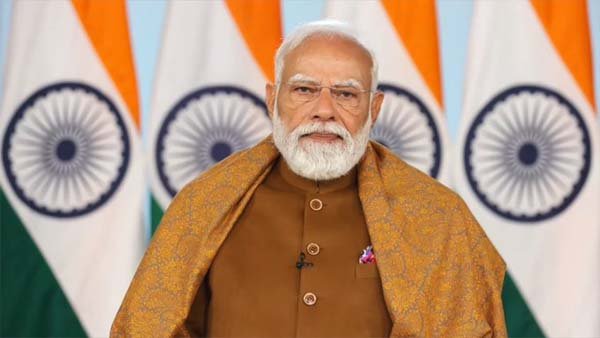
New Delh, Mar 2 (UNI) Prime Minister Narendra Modi on Monday described Canadian Prime Minister Mark Carney’s first visit to India as a “significant milestone,” unveiling an expansive roadmap to elevate bilateral ties into what he termed a “Next Level Partnership” spanning trade, clean energy, advanced technology, defence and people-to-people exchanges.
“It gives me great pleasure to welcome Prime Minister Carney to India. This is his first visit to India as Prime Minister, and we see it as an important milestone,” Modi said during a joint press statement, recalling the warmth extended to him at the G7 meeting hosted by Canada last year.
“At the G7 meeting held in Canada, he extended a warm welcome to me and my delegation. Today, it is my privilege to reciprocate that warmth and hospitality,” Modi said, adding in a personal note, “There are very few people in the world whose CV includes leadership of the central banks of two countries.”
From the outset of their engagement, Modi said, ties between New Delhi and Ottawa have gained renewed energy. “From our very first meeting, a new energy, mutual trust and positivity have infused our relationship. I credit my friend, Prime Minister Carney, for the growing momentum across every field of cooperation,” he said.
Framing the relationship around shared democratic values and pluralism, Modi underscored that both countries are united by a larger purpose. “India and Canada have unwavering faith in democratic values. We celebrate diversity. The welfare of humanity is our shared vision,” he said. “Today, we discussed transforming this vision into a Next Level Partnership.”
At the heart of the reset is an ambitious economic target: raising bilateral trade to $50 billion by 2030. Modi confirmed that both sides have decided to finalise the Comprehensive Economic Partnership Agreement (CEPA) at the earliest to unlock the full potential of trade and investment.
“Our goal is to take bilateral trade to 50 billion dollars by 2030. Unlocking the full potential of our economic cooperation is our priority,” he said. “This will create new opportunities for investment and employment in both countries.”
Highlighting the depth of financial linkages, Modi noted that Canadian pension funds have invested $100 billion in India, calling it “a reflection of their deep confidence in India’s growth story.” The two leaders were also scheduled to engage with top business executives to shape the next phase of economic collaboration.
Technology and innovation emerged as central pillars of the partnership. “In technology and innovation, we are natural partners. With the Canada and India innovation partnership, we will turn ideas into global solutions,” Modi declared, thanking Canada for its contribution to the AI Impact Summit hosted in India last month.
Beyond artificial intelligence, he outlined plans to expand cooperation in quantum technologies, supercomputing and semiconductors — areas seen as crucial to future competitiveness.
Energy security and sustainability formed another cornerstone of the talks. Modi announced a “landmark deal” for long-term uranium supply for civil nuclear energy and said both countries would collaborate on Small Modular Reactors and advanced nuclear technologies.
“In civil nuclear energy, we have reached a landmark deal for long-term uranium supply. We will also work together on Small Modular Reactors and advanced reactors,” he said.
He emphasised that environmental responsibility and economic stability go hand in hand, describing plans for a “Next Generation Partnership” in energy, with focus on hydrocarbons, renewable energy, green hydrogen and energy storage.
Modi welcomed Canada’s decision to join the International Solar Alliance and the Global Biofuels Alliance, announcing that an India-Canada Renewable Energy and Storage Summit would be held later this year to accelerate collaboration.
The leaders also signed an MoU on critical minerals aimed at strengthening resilient supply chains for clean energy technologies and advanced manufacturing. “The MoU signed today on critical minerals will strengthen resilient supply chains,” Modi said, adding that startups and industries from both countries would be connected in the space sector.
In agriculture, the two sides agreed to establish an India-Canada Pulse Protein Centre of Excellence to drive value addition, agri-technology innovation and food security — areas identified as shared priorities.
Defence and security cooperation, Modi said, reflects the “deep mutual trust and maturity” of the relationship. The two countries will enhance collaboration between defence industries, improve maritime domain awareness and expand military exchanges. To institutionalise this engagement, they decided to establish an India-Canada Defence Dialogue.
People-to-people ties — underpinned by a vibrant Indian diaspora in Canada — were described as the “real strength” of the partnership. Modi announced new university partnerships in AI, healthcare, agriculture and innovation, and confirmed agreement on Canadian universities opening campuses in India. An MoU was also signed to promote cultural exchanges, including collaboration involving indigenous and tribal communities.
Strategically, Modi said Canada is an important partner for India in the Indo-Pacific and welcomed Ottawa’s interest in becoming a Dialogue Partner in the Indian Ocean Rim Association, a move expected to deepen maritime cooperation.
On global challenges, both leaders voiced concern over terrorism, extremism and radicalisation. “These are shared and serious challenges not only for our two countries but for humanity as a whole. Our close cooperation against these threats is extremely important for global peace and stability,” Modi said.
Addressing geopolitical tensions, Modi reiterated India’s consistent call for peace and diplomacy. “When two democracies stand together, the voice for peace becomes even stronger,” he said, expressing deep concern over the situation in West Asia and affirming India’s commitment to dialogue and the safety of its citizens abroad.
Carney’s visit, rich in symbolism and substance, signals a determined effort by both governments to move beyond past strains and anchor the India-Canada partnership in shared democratic ideals, economic ambition and a forward-looking global outlook.