





Bhubaneswar, (UNI) Heritage enthusiasts stumbled upon amalgamation of Hindu and Buddhist culture in divinities in Odisha’s Jagatsinghpur district.
Heritage enthusiasts under the aegis of Jagatsinghpur Heritage Walks (JHW) explored the lesser-known and vibrant hot-spots which have deep-rooted links to the socio-religious fabrics of the region with references to Buddhism and Hindus.
While visiting the ancient Nagarjuna Temple and the Janardana Vishnu Temple in Kaduapada, located in Kalyanpur village on the outskirts of Jagatsinghpur town, heritage enthusiasts were overwhelmed to find Buddhism’s influences which later it got amalgamated with the common Hindu shrines and the deities.
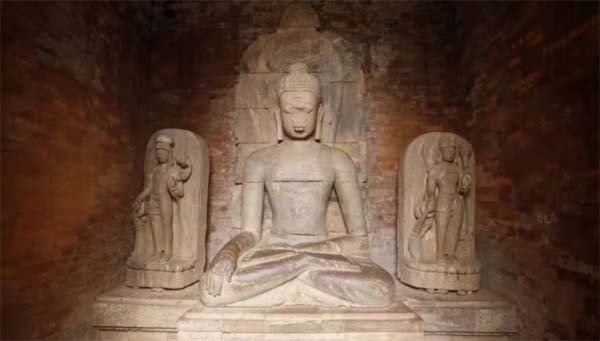
At Nagarjuna Peeth in Kalyanpur village, local residents have traditionally worshiped two ancient idols as manifestations of Lord Vishnu. However, upon closer inspection, these figures are clearly not representations of eternal Hindu deities but are directly linked to Buddhism: One is Bodhisattva Manjushri, and the other depicts Gautama Buddha in his descent from the heavens (Devavatran).
The presence of such Buddhist icons amid a region dominated by Shiva-Shakti worship is both remarkable and thought-provoking, inviting deeper inquiry into the site’s layered historical narrative.
Although no definitive evidence confirms the Buddha’s personal visit to Odisha, the ancient Kalinga region stood as a prominent stronghold of Buddhism. The Pali text Anguttara-Nikaya records that two Odia merchant brothers, Tapussa and Bhallika, became disciples of the Buddha and received a lock of his hair, which they enshrined in Odisha, initiating the spread of the faith there. The 7th-Century Chinese pilgrim Hiuen Tsang (Xuanzang), in his travelogue Si-Yu-Ki, described a renowned Buddhist university named Pushpagiri in Odisha, rivaling Nalanda in fame.
He also mentioned the area corresponding to present-day Jagatsinghpur district, noting a port called Chelitalo surrounded by numerous Buddhist monasteries. Investigations suggest Chelitalo was located in the Tirtol area, with nearby Buddhist-associated sites including Tarpur, Paradwip Gad, and Marichipur.
Nagarjuna Peeth is considered one such monastic establishment, likely inspired or established during the travels of the Mahayana master Nagarjuna.The principal idols at the site belong to the Mahayana tradition.
The first is Bodhisattva Manjushri, a central figure symbolising supreme wisdom and intelligence. In Buddhist doctrine, ignorance is the root of all suffering, and Manjushri is revered as the de-speller of that ignorance. Here, he is seated on a lion, holding a book and a lotus—emblems of profound knowledge, discernment, and courage. (In certain depictions, Manjushri wields a flaming sword to cut through the darkness of delusion.) The second idol represents the Buddha’s descent from Tavatimsa Heaven (Devavatran).
Legend holds that shortly after giving birth to Buddha, his mother, Queen Mahamaya, ascended to heaven. To repay his maternal debt and preach the Dharma, the Buddha ascended to heaven, where he taught both deities and his mother for three months. Upon his return to earth at Sankashya (in present-day Uttar Pradesh), he descended via three ladders constructed by the heavenly rulers: a golden central ladder for the Buddha, a silver one on the right for Brahma, and a stone one on the left for Indra (or Shakra).
Odisha: Heritage lovers stumble upon Buddhist influence on Hindu divinities