





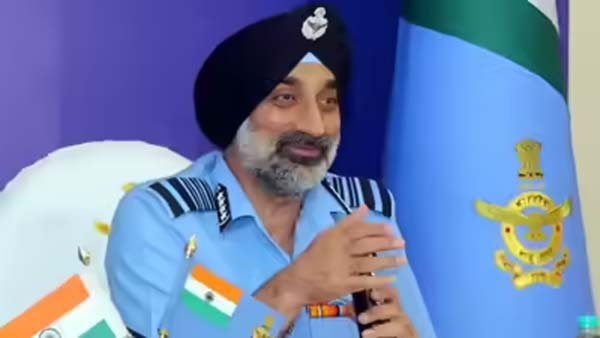
New Delhi, Jan 21 (UNI) Calling on the armed forces to look ahead rather than dwell on past successes, Air Force Chief Air Chief Marshal A P Singh on Tuesday stressed that air power has repeatedly proven its value on the battlefield and will be central to India’s military strength in the years to come, urging a sharper focus on preparing for future challenges if the country is to remain a force to reckon with.
The Chief of Air Staff was speaking at the 22nd Subroto Mukherjee Seminar organised by the Centre for Aerospace Power and Strategic Studies (CAPSS) in the national capital here today.
Speaking about the role of IAF in country’s modern warfare especially during the counter-terror operations, the ACM spoke about the multiple precision strikes carried out by IAF during Operation Sindoor to neutralise the terror bases and targets located deep inside Pakistan.
“What is happening around the world and what has happened in India… which part of military power which has come in handy… which has delivered what was required to be delivered… I think I don’t have to name it – it is the air power, and it becomes very important that we focus our attention to this part of the military if we want a force to reckon with,” he said.
Whether it is getting people out of conflict zones, like we did it in Sudan or whether it is giving a blow to the terrorist infrastructure and their perpetrators or whether it is attacking multiple bases in Pakistan in a matter of few hours to send a signal that enough is enough and bring them to their knees. It was air power that did the trick and that has to be remembered,” the CAS added further.
Singh further warned against any sense of complacency, calling on the armed forces to sharpen their preparedness for emerging challenges in a rapidly changing and uncertain global security landscape. Stressing the need to look ahead, he said, “Let us not rest on past glory. Let us brace up for the future challenges.”
Speaking about the changing dynamics of national security, the CAS while citing examples of Venezuela and Iraq said that economic strength alone can’t ensure security. “We must understand that military power stands as the ultimate arbiter of national power. Anybody can be economically sound but can’t be secure,” he said.
“We have the example of our own country, we plus China controlled 60 per cent of worlds GDP at one time, but that didn’t stop us from getting captured and colonised. Any one of these powers is very important, but finally, what is required is a robust military, because if you don’t have it, you can be subjugated by anybody. Venezuela and Iraq are the most recent examples. It is the military power which is important, but what is more important is the will to use that military power,” he added further.
During the annual presser held in October last year, the IAF chief had said that the they struck a large number of Pakistan’s airfields and installations in the strikes carried out during Op Sindoor.
Outlining the damage inflicted on Pakistan, the IAF chief had revealed, “As far as Pakistan’s losses are concerned, we have struck a large number of their airfields and we struck a large number of installations. Because of these strikes, radars at least four places, command and control centres at two places, runways of course damaged at two places, then three of their hangars in three different stations have been damaged. We have signs of one C-130 class of aircraft…and at least 4 to 5 fighter aircraft, most likely F-16, because that place happened to be F-16 with whatever was under maintenance at that time.
Along with that, one SAM system has been destroyed. We have clear evidence of one long-range strike, which I talked about more than 300 km, which happened to be either an AWACS (Airborne Warning and Control System) or a SIGINT aircraft, along with those five high-tech fighters between F-16 and JF-17 class. This is what our system tells us,” Singh had said.