





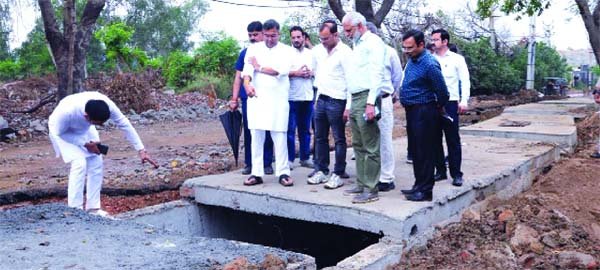
New Delhi, (UNI) Delhi PWD minister Parvesh Sahib Singh Verma on Sunday inspected the ongoing storm water drain improvement project along Rohtak Road (NH-10) and reviewed progress of additional irrigation and flood control works aimed at addressing chronic waterlogging in several parts of West Delhi.
During the inspection, the Minister said the project has entered its final stage and is expected to bring long-awaited relief to thousands of residents who face water accumulation during heavy rainfall.
The primary project involves the construction and strengthening of a large storm water drainage network along the Rohtak Road corridor to facilitate smooth discharge of rainwater and prevent flooding on one of West Delhi’s major arterial roads.
Officials informed the Minister that the project includes development of storm water drains from the Kirari Suleman Drain near Nangloi Metro Station to the Hiran Kudna Drain, covering stretches between Metro Pillar numbers 428 to 626 and from Tikri Border to Hiran Kudna Drain on both sides of the road.
The project is being executed at an estimated cost of about Rs 113.98 crore.
According to officials, the RCC drain under construction has a width ranging from 1.2 metres to 2.25 metres and is designed to handle heavy storm water flow during peak monsoon conditions.
Approximately 16,000 metres of the drain network has already been completed, while about 2,200 metres of work is still underway. The project commenced in February 2025 and has progressed steadily since then.
The drainage network is being developed along the stretch from Nangloi Railway Metro Station to Tikri Border, with the remaining portion currently under execution between Ghevra Metro Station and Tikri Kalan Metro Station.
Speaking during the inspection, Verma said solving the problem of waterlogging in West Delhi has been a long-standing demand of residents.
“For many years, people living in areas such as Mundka, Rajdhani Park and nearby localities have faced severe inconvenience during the monsoon season due to water accumulation on roads and in residential colonies. This project has been designed to address that issue in a systematic and permanent manner,” he said.
The Minister explained that once completed, the upgraded drainage network will allow rainwater to flow smoothly from the Nangloi region into the Kirari Suleman Drain and further into the Hiran Kudna Drain, enabling faster disposal of storm water.
“With this improved drainage system, rainwater will be cleared much faster from roads and surrounding areas. Residents and commuters should no longer have to face flooded roads and traffic disruptions during heavy rainfall,” he added.
Alongside the storm water drain project, an irrigation and flood control initiative has also been implemented in the same region to further strengthen the drainage infrastructure.
The project, approved at a cost of Rs 23.51 crore, focuses on diverting discharge from the Kirari Suleman Drain along Rohtak Road into the Supplementary Drain to improve water flow management during periods of heavy rainfall.
Officials informed the Minister that the irrigation and flood control project has already been completed and will significantly enhance drainage capacity in the area.
The improved linkage is expected to benefit residents of Kirari and adjoining areas including Kirari Extension-2, Veena Enclave, JJ Colony No. 2 and Janta Market, which frequently face waterlogging during the monsoon.
Verma said the government is prioritising improvement of drainage infrastructure across the city to better prepare Delhi for the monsoon season.
“Drainage infrastructure may not always be visible like roads or flyovers, but it plays a crucial role in daily life. A well-designed drainage system ensures roads remain functional, neighbourhoods remain safe from flooding and people do not suffer during heavy rains,” he said.
He added that the combination of the PWD storm water drainage project and the irrigation and flood control work will provide a long-term solution to drainage challenges in the region.
The Minister also directed officials to ensure that the remaining construction work is completed at the earliest while maintaining strict quality standards so that the infrastructure functions efficiently for years to come.
Once completed, the Rohtak Road storm water drainage project is expected to significantly reduce waterlogging and ensure smoother traffic movement across several parts of West Delhi during the monsoon season, Officials said.