






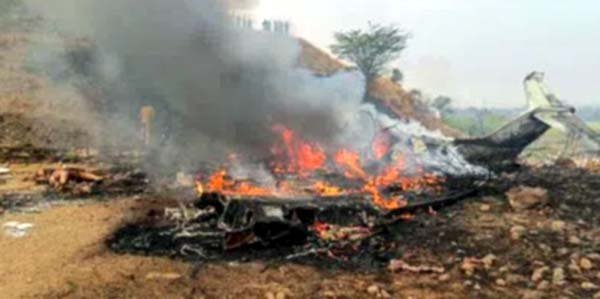
New Delhi, Feb 28 (UNI) The preliminary investigation report on the January 28 plane crash in Baramati, Maharashtra revealed that the visibility was below the minimum limits, when the accident took place, while lapses were surfaced in the airstrip and the runway maintenance.
The crash had claimed lives of five people who were on board the plane, inlcuding then Maharashtra Deputy CM Ajit Pawar.
VSR Ventures’ Learjet 45 XR aircraft (registration VT-SSK) was carrying Pawar from Mumbai to Baramati, and while trying to land It crashed and caught fire on the left side of runway 11.
The report states that operation at Baramati airstrip is only permitted as per the VFR (Visual Flight Rules), and according to them, minimum 5 KM visibility is required. Based on the communication between the pilot ant the ATC, it has been known that visibility at that time was 3KM, and the ATC had informed the pilots about it.
As per the satellite imagery obtained, images show that there were no clouds around Pune at that time, however, Baramati which was 81 km away, had light fog. Along with Pawar, his private security officer, both the pilots and a cabin crew also got killed.
The report says that the last time re-carpeting of the runway was done ten years ago in March 2016, and presently the markings on the runway had faded, while small stones were protruding from the runway surface.
There were no permanent ambulance or firefighting facilities were deployed at the airstrip by the Baramati municipal corporation, the report said.
The Aircraft Accident Investigation Bureau (AAIB) has informed that the data from the Solid State Flight Data Recorder (SSFDR) has been downloaded, and the data from the Solid State Cockpit Voice Recorder (SSCVR) will be dowloaded with the help of America’s National Transportation Safety Board (NTSB).
The probe agency had also given information on the communication between the ATC and the pilot, which tells that the aircraft first contacted the Baramati ATC at 8.19 AM and that time it was informed that it was 30 miles away from the runway.
The next communication was at 8.27 AM, when the plane was 10 miles away, and the ATC had told to land at runway 11, however, pilot requested for landing at runway 29, which the ATC had accepted.
However, after two minutes, the pilot again sought permission for landing at runway 11, which was accepted, and at that time the ATC informed that the visibility was 3 KM, and the pilot instead of landing in the first attempt decided to take a round.
In the second attempt, the pilot requested for permission for landing at runway 11 at 8.40 AM, but while trying to land the accident took place.
“The controller informs visibility as 3 Kms. However, the aircraft continued approach and subsequently carried out go-around. During the second approach the aircraft reported field in sight and subsequently landing clearance was given by the Baramati tower for runway 11. The tower also informed the winds as calm. Later the aircraft was heard transmitting “Oh S**t… Oh S**t…”, before it crash landed on the left side of the runway abeam runway 11 threshold,” the report says.