




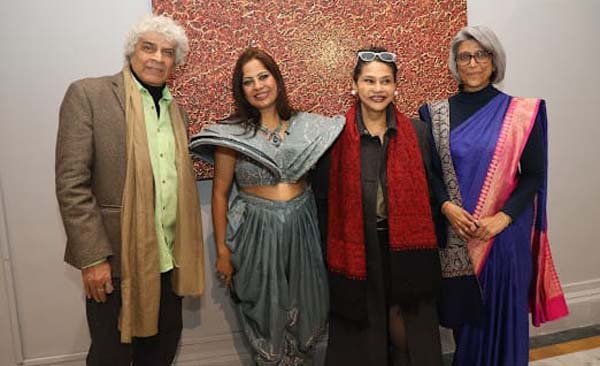
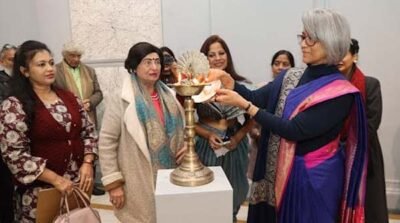
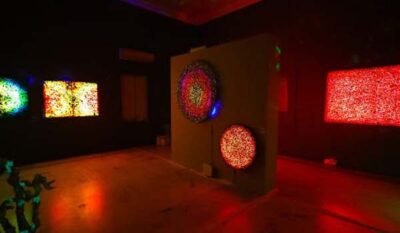
New Delhi, In a contemporary art world often driven by visibility, spectacle and constant display, Sonika Agarwal has cultivated a practice rooted in stillness, continuity and inward reflection. This quiet yet rigorous process finds expression in her solo exhibition What Remains Awake: Dream, Depth, and the Fourth, currently on view at Kalanmakar Gallery, Bikaner House, New Delhi, from 30 January to 10 February 2026.
A self-taught artist with over seventeen years of sustained practice, Agarwal’s journey has unfolded alongside the multiple roles women frequently inhabit artist, seeker, professional, and an individual negotiating expectation and self-determination. Rather than separating life from art, she allows the two to merge seamlessly. Her work draws deeply from the ancient Indian conception of consciousness jāgrat (wakefulness), svapna (dream), suṣupti (deep sleep) and turīya, the fourth state beyond thought—forming a language that is at once philosophical and intensely personal.
In contrast to more traditional narrative or figurative modes often associated with women’s expression, Agarwal chooses abstraction as a site of resistance and introspection. Her paintings, sculptures and installations do not explain; they invite. Subtle shifts of colour, breathing surfaces, and forms hovering between presence and absence gesture towards the emotional labour, endurance and inner worlds that women frequently carry invisibly.
Curated by Mayna Mukherjee, the exhibition situates Agarwal’s work within a wider discourse on embodied experience and non-Western knowledge systems. Sculptural works such as Vasana: The Architecture of Desire examine how latent impressions desire, memory and ambition
shape the architecture of the mind, while Dominance over the Silence of Ahimsa reflects on power, vulnerability and ethical responsibility through the tense dynamic of predator and prey. These are not declarative feminist statements, but meditative reflections on agency, restraint and choice.
Agarwal’s artistic trajectory has been shaped less by institutional patronage and more by continuity and disciplined practice. The prestigious National Stree Shakti Award, conferred by the President of India, recognises not only her artistic excellence but also her contribution to shaping cultural discourse with quiet resolve. More recently, the acquisition of her works by the Museum of Sacred Arts (MoSA) in Belgium underscores the global resonance of her introspective practice.
Ultimately, What Remains Awake stands as a reflection of a profound feminine strength one that listens more than it proclaims, and observes more than it demands. By inviting viewers to slow down and encounter states of consciousness beyond productivity and performance, Sonika Agarwal opens a contemplative space that feels especially urgent today. It is a reminder that, for many women, the most radical act still remains the same: to stay awake within, despite the noise without.