


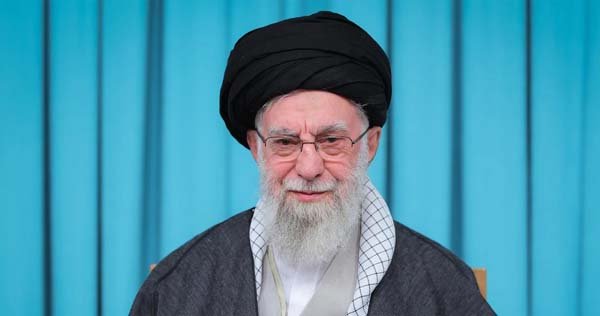
Tehran/Washington, March 1, (UNI) Iran’s Supreme Leader Ali Khamenei was killed in a joint US-Israeli strike on Tehran early Sunday, Iranian media confirmed.
Iranian state media said Khamenei was killed in strikes that targeted areas in northern Tehran, including locations near his compound and offices. The semi-official Tasnim news agency reported that multiple missiles hit areas close to the presidential palace in Shemiran and near the Supreme Leader’s residence.
This escalation threatens to reshape the Middle East, as Trump said the operation marked the “single greatest chance” for the Iranian people to “take back” their country, while Iran said it would carry out a massive offensive.
Iran’s Fars News Agency said Khamenei was killed “in his office in the household of the leader” while “carrying out his duties” when the strikes hit the capital. State television later confirmed his death.
In a further blow to the Iranian leadership, state-linked media reported on Sunday that Khamenei’s daughter, son-in-law, and granddaughter were also killed in the attacks.
“After establishing contact with informed sources in the Supreme Leader’s household, the news of the martyrdom of the daughter, son-in-law and granddaughter of the Revolutionary Leader has unfortunately been confirmed,” Fars said. It was not immediately clear which of Khamenei’s three daughters was among the victims.
US President Donald Trump confirmed Khamenei’s death in a post on Truth Social.
“Khamenei, one of the most evil people in History, is dead,” Trump wrote. “This is not only Justice for the people of Iran, but for all Great Americans, and those people from many Countries throughout the World, that have been killed or mutilated by Khamenei and his gang of bloodthirsty THUGS.”
He added that the operation marked the “single greatest chance” for the Iranian people to “take back” their country and said “heavy and pinpoint bombing” would continue “uninterrupted” for as long as necessary to achieve “peace throughout the Middle East.”
Iran’s Revolutionary Guards warned on Sunday that the “heaviest offensive operations in the history” of the Islamic Republic’s armed forces would begin imminently, following the killing of Supreme Leader Ali Khamenei in joint U.S.-Israeli strikes.
“The heaviest offensive operations in the history of the Armed Forces of the Islamic Republic of Iran will begin shortly toward the occupied lands and bases of the American terrorists,” the Islamic Revolutionary Guard Corps (IRGC) said in a statement.
Iran’s government described the killing as “a great crime” that would “never remain unanswered and will turn a new page in the history of the Islamic world.”
The Supreme National Security Council (SNSC), Iran’s top security body, said the joint attacks would “begin a massive uprising in fighting the world’s oppressors” and vowed that Iran and its allies would emerge “more resilient and determined.”
Within hours of the threats, Iranian ballistic missiles struck central Tel Aviv, according to Israeli authorities and eyewitnesses. Explosions were heard across the city, and emergency services responded to multiple impact sites.
Khamenei, 86, has been the ultimate head of religious and political figure as well as the military head in Iran since 1989, succeeding Ruhollah Khomeini, the founder of the Islamic Republic. As Supreme Leader, he held ultimate authority over Iran’s government, armed forces, and judiciary, and served as the country’s highest religious authority.
Throughout his tenure, Khamenei oversaw Iran’s tense relationship with the West, weathering sweeping sanctions, domestic unrest, and repeated standoffs over Tehran’s nuclear programme.
Israeli Prime Minister Benjamin Netanyahu said there were “many signs” that Khamenei was “no longer alive.”
“This morning we destroyed the compound of the tyrant Khamenei,” Netanyahu said in a video statement. “There are many signs that this tyrant is no longer.”
He said Israeli forces had also “eliminated senior officials in the ayatollahs’ regime” and vowed further strikes in the coming days. Netanyahu called on Iranians to “overthrow the regime and secure your future.”
The Israeli military claimed that senior Iranian figures, including Ali Shamkhani and Revolutionary Guards commander General Mohammad Pakpour, were also killed in the operation.
The United States and Israel launched a massive, coordinated military strike against Iran on the morning of February 28, targeting multiple cities across the country, including Tehran, Qom, Isfahan, Kermanshah, and Karaj.
Israel has officially designated its campaign “Operation Lion’s Roar,” while the Pentagon is referring to the American military action as “Operation Epic Fury.” The Islamic Revolutionary Guard Corps (IRGC) code-named its operation “True Promise-4.”
The US said the mission is aimed at eliminating imminent threats and ensuring Iran never possesses a nuclear weapon. The conflict has expanded into a multi-theatre confrontation, raising fears of a broader Middle Eastern war.
In retaliatory strikes, Iran launched a wave of drones and ballistic missiles directly targeting northern Israel and Tel Aviv.
The conflict expanded beyond Israel and Iran, threatening American assets in the Persian Gulf. Bahrain’s official news agency reported that a missile attack targeted the headquarters of the US Navy’s Fifth Fleet in Manama. Reports of explosions also came from Qatar and the UAE.
The Middle East airspace has been severely disrupted. Iran, Israel, Iraq, the UAE, Bahrain, and Qatar have all indefinitely closed their airspace, causing massive flight diversions and groundings worldwide.
The IRGC said the American FP-132 radar, with a range of 5,000 kilometres and stationed in Qatar, equipped with unique technology used to intercept ballistic missiles, has been destroyed.
On Sunday, US Ambassador to the UN Mike Waltz said, “The Iranian regime has even attempted to assassinate the US president President Donald Trump. Now they are masquerading as a victim. Now we have taken lawful action.”
The US shunned diplomacy and carried out strikes while negotiations were ongoing. The US and Israeli attacks took place even as the two sides had concluded three rounds of negotiations in Geneva to resolve the stalemate. Moderated by Oman, the negotiations were described as successful, even as the US had positioned two aircraft carriers in the area, ostensibly to pressure Iran. Iran’s Supreme Leader Ali Khamenei had warned that if the US attacked Iran, they (Iran) would involve the entire region.
While peace negotiations continued, US President Donald Trump said he was unhappy with the progress of talks with Iran over a potential nuclear deal. “I’m not happy with the fact that they’re not willing to give us what we have to have. I’m not thrilled with that.”
With Mike Waltz defending the strikes as “lawful action” and accusing Tehran of plotting against President Donald Trump, the attack has further fuelled arguments that diplomacy may have been little more than a façade. Iran has long maintained that it does not trust the United States, repeatedly warning that Washington’s ultimate objective was not a nuclear agreement but the dismantling of the Islamic Republic itself.
The strikes, carried out even as negotiations were ongoing, are likely to reinforce Tehran’s claim that the talks were conducted in bad faith and that regime change, rather than nuclear restraint, was the underlying goal.