






Jayanta Roy Chowdhury
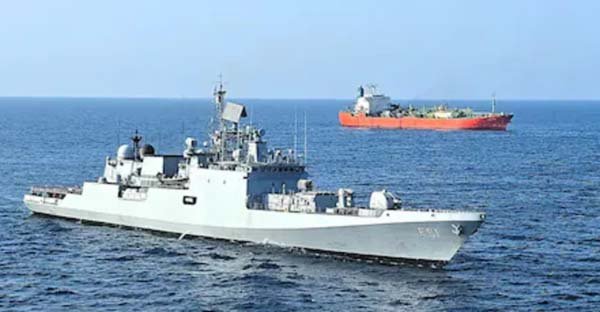
New Delhi, March 16 (UNI) As the first of three Indian flagged vessels, Shivalik, carrying precious oil and gas for Indian shores, berthed at Gujarat’s Mundra port on Monday after safely crossing the gauntlet of the Strait of Hormuz, Indian officials who were monitoring the situation heaved a sigh of relief.
This was the first of what they hope will be a fleet of tankers which will come through the Strait. Another ship, Nandadevi, which also crossed the Strait of Hormuz safely, is expected to arrive at Kandla Port on Tuesday, while ‘Jag Laadki’ is expected to follow suit.
“Some two dozen Indian flagged ships and tankers are operating in Gulf area right now and of these three ships have crossed the Straits without any mishap … we are working on and hoping for more to follow,” said Pinak R Chakravarty, former Secretary (Economic Relations) in the Ministry of External Affairs.
Indian diplomats have been burning the hotline with Teheran to get ships through. External Affairs Minister S Jaishankar told a newspaper earlier, “I am at the moment engaged in talking to them and my talking has yielded some results.” The career diplomat turned politician, however, has said there were no “blanket arrangements” for all Indian vessels.
“We have been also quietly cooperating with Iran, which has been a long-standing partner for us … two Iranian naval ships were docked here after the conflict broke out and the crew was repatriated,” pointed out Chakravarty.
Saudi Arabia already has an East West pipeline which takes crude from its eastern provinces near Qatar to the Red Sea coast at Yanbu and is believed to be transferring significant oil through that route too.
Earlier on Sunday, US President Donald Trump said that some seven nations had been approached to help safeguard commercial vessels passing through the narrow waterway.
Though Trump did not name the countries, a day earlier, in a social media post, he had said that he hopes countries like “China, Japan, South Korea and the UK and others that are affected by this artificial constraint, will send ships” to patrol the crucial Strait.
However, Japan has already indicated that it may not be willing to help patrol the Strait.
“On a map, the Strait looks deceptively modest but it’s the world’s most effective chokepoint. We should for the long run convince the Gulf Cooperation Council with whom we have a trade pact to build a pipeline to the Omani coast bypassing the Strait,” said Chakravarty who was involved in India’s economic diplomacy.
The Strait stretches roughly 104 miles, narrowing at points to little more than 20 miles across. For the world, this confined maritime channel flows roughly one-fifth of the world’s traded oil.
Tankers moving from the energy-rich states of the Gulf, Saudi Arabia, Iraq, Kuwait, Qatar, and the United Arab Emirates, must squeeze through shipping lanes just a few miles wide before entering the open waters of the Arabian Sea.
The scale of traffic is staggering. Around 20 million barrels of oil and petroleum products pass through the Strait every day, along with a substantial share of the world’s liquefied natural gas exports. It is, quite literally, the artery of global energy.
Few major economies are as exposed to this chokepoint as India.
“India is the world’s third-largest consumer of oil and a significant portion of that supply originates in the Gulf and must travel through Hormuz before reaching Indian ports, that is why the Indian navy has given a lot of importance to that area at all times,” explained Commodore Ranjit Rai, former Director of Naval Intelligence.
Roughly two to three million barrels of crude oil per day transit the Strait on their way to refineries along India’s western coast.
The dependence is even sharper in natural gas. Qatar, one of the world’s largest LNG exporters, supplies roughly half of India’s imported liquefied natural gas. Nearly all of it moves through Hormuz.
In other words, a disruption in the Strait would not merely affect global markets. It would quickly touch the daily functioning of the Indian economy, fuelling cars, powering factories, and sustaining electricity generation.
Recognising this vulnerability, India has quietly worked to diversify its energy sources. In recent years it has sharply increased crude imports from Russia, which are transported by sea routes that do not pass through Hormuz.
Yet geography imposes limits on diversification. The Gulf remains the world’s densest cluster of low-cost oil producers, and for India it will likely remain the most important supplier for years to come.