


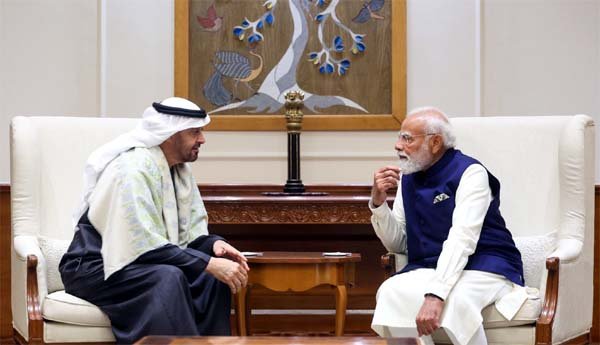
New Delhi, Jan 19 (UNI) India and the United Arab Emirates (UAE) on Monday set an ambitious target to double bilateral trade to USD200 billion by 2032, as Prime Minister Narendra Modi and UAE President Sheikh Mohamed bin Zayed Al Nahyan (MBZ) reviewed the expanding canvas of the Comprehensive Strategic Partnership and agreed to further deepen cooperation across trade, investment, energy, technology, defence and people-to-people ties.
President Sheikh Mohamed bin Zayed Al Nahyan was on his fifth visit to India in the last decade and his third official visit as UAE President, underscoring the momentum in ties. The two leaders noted that the partnership has “continued to strengthen over the past decade,” driven by sustained high-level engagement and expanding economic cooperation.
Welcoming the UAE President, Prime Minister Modi said the relationship had evolved into a “future-oriented partnership” anchored in trust and shared interests.
President Nahyan thanked PM Modi for the “warm welcome and gracious hospitality,” reaffirming the UAE’s commitment to deepening ties with India.
The leaders welcomed the robust growth in trade since the signing of the Comprehensive Economic Partnership Agreement (CEPA) in 2022, noting that bilateral trade reached USD100 billion in FY 2024–25. Buoyed by strong business interest on both sides, they agreed to work towards doubling trade by 2032.
They also directed their teams to enhance connectivity between Micro, Small and Medium Enterprises (MSMEs), calling for the expeditious implementation of initiatives such as Bharat Mart, the Virtual Trade Corridor and Bharat-Africa Setu to promote MSME products across West Asia, Africa and Eurasia.
The two leaders endorsed the outcomes of the 13th High-Level Task Force on Investments (September 2025) and the 16th Joint Commission Meeting and 5th Strategic Dialogue (December 2025). They expressed satisfaction that the Bilateral Investment Treaty signed in 2024 has boosted investment flows and welcomed discussions on a potential UAE partnership in developing the Special Investment Region at Dholera, Gujarat, including strategic infrastructure such as an international airport, greenfield port, smart township, rail connectivity and energy facilities.
Prime Minister Modi invited UAE sovereign wealth funds to consider participating in the second NIIF Infrastructure Fund, scheduled for launch in 2026. The leaders also welcomed the establishment of DP World and First Abu Dhabi Bank (FAB) branches in GIFT City, reinforcing its role as an international financial hub.
Highlighting the depth of the energy partnership, the leaders welcomed the signing of a 10-year LNG supply agreement between HPCL and ADNOC Gas for 0.5 million tonnes per year beginning 2028. They also noted that India’s SHANTI law opens new avenues for civil nuclear cooperation, including large reactors and Small Modular Reactors (SMRs), along with collaboration on safety, operations and maintenance.
Both sides reaffirmed their commitment to food security, emphasising public-private partnerships, innovation and knowledge exchange to ensure resilient and sustainable supply chains.
The leaders agreed to deepen cooperation in the space sector, welcoming an understanding to collaborate on a joint initiative aimed at commercialising space sciences and technologies, enabling joint missions, global services, start-ups and high-skilled employment.
They also decided to strengthen collaboration in science, technology and innovation, particularly in artificial intelligence and emerging technologies. Welcoming plans to establish a supercomputing cluster in India and explore cooperation on data centres, the leaders directed officials to examine the possibility of setting up “Digital Embassies” under mutually recognised sovereignty arrangements.
President Nahyan expressed support for the AI Impact Summit to be hosted by India in February 2026.
Reaffirming respect for each other’s sovereignty and strategic autonomy, the two leaders described defence and security cooperation as a core pillar of the partnership. They welcomed recent exchanges of visits by service chiefs, successful bilateral exercises, and the signing of a Letter of Intent towards a Strategic Defence Partnership.
They reiterated their unequivocal condemnation of terrorism in all its forms, including cross-border terrorism, and agreed to continue cooperation under the FATF framework to counter terror financing and strengthen anti-money laundering efforts.
Recognising shared cultural heritage, Prime Minister Modi welcomed the UAE’s decision to provide artefacts for the National Maritime Heritage Complex at Lothal. The leaders agreed to establish a ‘House of India’ in Abu Dhabi as a lasting symbol of friendship and to promote youth exchanges.
Education was identified as a cornerstone of ties, building on the offshore campuses of IIT Delhi and IIM Ahmedabad in the UAE. The leaders encouraged greater university linkages, student exchanges, expansion of Innovation and Tinkering Labs, and welcomed plans to integrate India’s DigiLocker with UAE platforms for seamless authentication of academic documents.
The two leaders recalled the launch of the India–Middle East–Europe Economic Corridor (IMEC) at the G20 Summit in Delhi in 2023 and exchanged views on regional and global issues, underscoring their shared interest in peace, stability and multilateral cooperation. The UAE conveyed full support for India’s BRICS Chairmanship in 2026, while India backed the 2026 UN Water Conference to be co-hosted by the UAE.
They also highlighted growing cooperation in polar science, agreeing to advance joint research and institutional collaboration to support global climate action.
The visit reaffirmed the India-UAE partnership as one of India’s most dynamic bilateral relationships, with both leaders signalling intent to elevate it to new strategic and economic heights in the coming decade.