



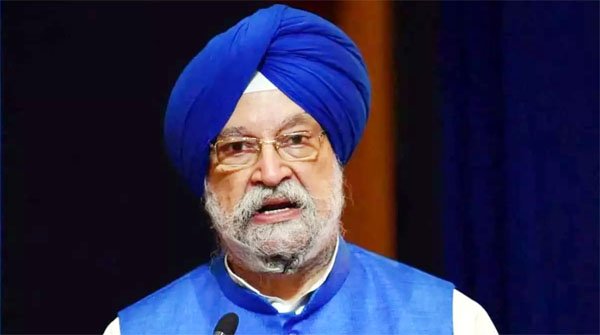
New Delhi, Jan 23 (UNI) Amid heightened geopolitical uncertainty and shifting global energy dynamics, India is positioning itself as a stable, reform-oriented and diversified energy partner, union Minister of Petroleum and Natural Gas Hardeep Puri said on Friday, highlighting sweeping policy changes and market-driven strategies ahead of the India Energy Week (IEW) 2026.
Addressing the curtain raiser ahead of the IEW 2026, slated to be held from January 27–30 January at ONGC’s Advanced Training Institute (ATI), Goa, the Minister spoke about India’s global energy engagement and foreign investment incentives ahead of the mega event.
Stating that the preparation for IEW is not episodic but continuous, the Minister said, “You don’t prepare for an IEW five days in advance. It’s something that goes on all the time,” he said, indicating that reforms unveiled at the forum are the outcome of sustained policy evolution.
“A key pillar of India’s investment push has been the opening up of its vast sedimentary basins for exploration,” the Minister said, adding that India has nearly 3.5 million square kilometres of sedimentary basin area, much of which remained underutilised for decades.
“A little while ago, the Prime Minister opened up one million square kilometres of this basin for exploration and production,” he said, adding that the response from investors has been significant.
According to the Minister, nearly 80 per cent of bids in the ninth round of the Open Acreage Licensing Policy (OALP) came from areas that were earlier designated as no-go zones due to strategic and security considerations.
He noted that while domestic and defence priorities will always exist, the government’s intent is now clearly aligned towards enabling energy exploration alongside national security needs.
Highlighting legislative reforms aimed at improving ease of doing business, the Minister pointed to the enactment of the Oilfields (Regulation and Development) Amendment Act, 2025, calling it a “very progressive” law.
He said the legislation replaced a colonial-era framework dating back to 1948 that governed both mining and petroleum operations. “We have been able to separate the two because there are fundamental differences,” he said.
On India’s strategy amid global supply disruptions and geopolitical volatility, the Minister said the country has significantly diversified its crude oil sourcing. India earlier imported crude from around 27 countries; today, that number has increased to 41. “We basically allow the market to propel the essential decision,” he said.
The Minister acknowledged that navigating supply disruptions remains challenging, particularly when traditional suppliers become constrained. He recalled that when he assumed office five years ago, a majority of India’s crude imports came from a handful of West Asian suppliers. “Today, it’s different. We have new suppliers,” he said, noting that market conditions continue to evolve.
While uncertainty remains over potential future supplies from countries like Venezuela and Iran, the Minister expressed confidence that global energy availability would expand.
“The country is focused on maintaining strong relationships with traditional partners while adapting to emerging energy geographies,” he said while stating that India would continue to “navigate forward” in an increasingly complex global energy landscape.