





Shahid K Abbas and Sourav Shekhar
New Delhi, Jan 27 (UNI) In a landmark moment heralded as a transformative milestone for global commerce, India and the 27-nation European union officially concluded the long-awaited India-EU Free Trade Agreement (FTA) on Tuesday. Prime Minister Narendra Modi described the pact as “not just a trade agreement, but a new blueprint for shared prosperity,” emphasising its significance for the 1.4 billion people of India and millions across Europe.
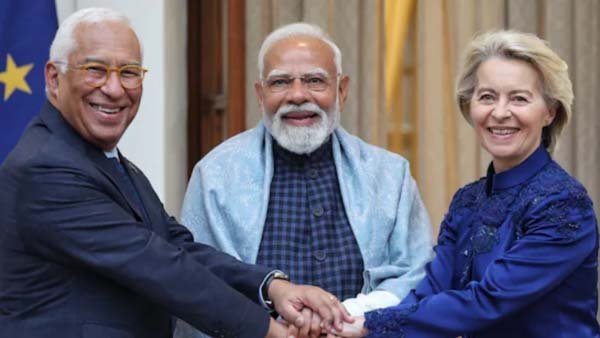
The announcement came at a joint press conference in New Delhi following the 16th India-EU Summit, attended by European Commission President Ursula von der Leyen and European Council President António Costa. The comprehensive agreement, nearly two decades in negotiation and re-energised since 2022, is India’s largest and most ambitious trade deal to date, covering over 99 per cent of trade in goods and services by value, and unlocking unprecedented market access on both sides.
Although the trade agreement was concluded, it will, however, take the two sides at least six months to formally ratify the pact which has been concluded by the two leaderships.
“This is a milestone moment for 1.4 billion Indians and the citizens of Europe,” Prime Minister Modi stated. “India today inked its biggest free trade deal with the 27-nation European Union. This agreement is a decisive step in strengthening the India-EU strategic partnership, representing around 25 per cent of global GDP and one-third of global trade.”
Earlier in the day the Prime Minister had also announced the signing of the India-EU FTA pact, describing it as a landmark deal that accounts for 25 per cent of global GDP and one-third of global trade. The announcement was made during his virtual address at the India Energy Week 2026 conclave.
“I am informing you about a big development … a significant agreement was signed between India and Europe yesterday (Monday),” PM Modi said, congratulating all stakeholders involved. He added, “People are discussing it as the ‘mother of all deals,’ and this agreement has brought a lot of opportunities for 140 crore Indians and crores of Europeans.”
The India-EU FTA is expected to significantly boost manufacturing, services, investment, and job creation across both regions. Key sectors such as textiles, leather, marine products, gems and jewellery, and engineering goods stand to gain from reduced tariffs—up to zero on many exports—empowering workers, artisans, and MSMEs. The deal also includes a calibrated liberalisation of the automobile sector, with India agreeing to gradually reduce tariffs on EU cars while safeguarding its emerging electric vehicle industry.
European Commission President Ursula von der Leyen hailed the agreement as “the mother of all deals,” underscoring its potential to create millions of jobs and open “unprecedented opportunities for businesses and innovators.” European Council President António Costa echoed this, calling trade “a crucial geopolitical stabilizer and a fundamental source of economic growth,” and highlighting the creation of a market for nearly two billion people.
Beyond trade, the summit also saw the launch of a comprehensive mobility framework facilitating the movement of skilled professionals, as well as an enhanced Security and Defence Partnership focusing on maritime security, counter-terrorism, cybersecurity, and joint defence industrial cooperation. This reflects a growing strategic convergence between New Delhi and Brussels amid shifting global geopolitics.
“This partnership is a partnership for global good,” Prime Minister Modi affirmed. “We are united in our belief that reform of global institutions is essential to address today’s challenges.” He linked the agreement to deepening political trust, recalling the historic participation of EU leaders at India’s Republic Day celebrations and underscoring the momentum in bilateral relations.
Union Commerce Minister Piyush Goyal praised the agreement as “a defining achievement in India’s economic engagement and global outlook,” noting that it supports India’s ‘Make in India’ initiative and opens new avenues for innovation, competitiveness, and inclusive growth.
Trade figures between India and EU underscore the significance of this partnership: In 2024-25, bilateral trade in goods reached Rs 11.5 lakh crore (USD 136.54 billion), with services trade at Rs 7.2 lakh crore (USD 83.10 billion). The agreement further integrates two of the world’s largest economies—India, the world’s fourth largest, and the EU, the second—positioning them as trusted partners committed to open markets and sustainable development.
The deal includes forward-looking provisions on clean energy cooperation, digital trade, green technologies, and connectivity projects such as the India-Middle East-Europe Economic Corridor (IMEC), reinforcing a shared vision for a balanced, modern, and rules-based economic partnership.
As PM Modi affirmed, “Bharat aur European union ka sahyog kewal arthik nahi hai, ye bhavishye ki vaishwik vaiwasta ko adhik resilient aur isthir banane ki disha mein ek nirnayak kadam hai.” (India and the European Union’s cooperation is not just economic; it is a decisive step towards making the future global order more resilient and stable.)
This historic Free Trade Agreement marks a new chapter in India-EU relations, setting the stage for robust economic growth, strengthened strategic ties, and a resilient partnership in an increasingly multipolar world.
The agreement includes significant tariff reductions, with India cutting tariffs on 99.5 per cent of EU goods, including eliminating tariffs on Indian marine products, leather, textiles, chemicals, and gems. India will gradually reduce tariffs on EU cars to 10 per cent, while safeguarding its electric vehicle industry. European companies are expected to save around Euro 4 billion in duties.
The deal also establishes a mobility framework to facilitate business travel and the movement of professionals between India and the EU. Additionally, a Security and Defence Partnership will enhance cooperation in maritime security, cybersecurity, and defense industries.
This comprehensive agreement solidifies the India-EU partnership as a foundation for economic resilience, innovation, and global stability in the years ahead.