


By Naem Nizam,
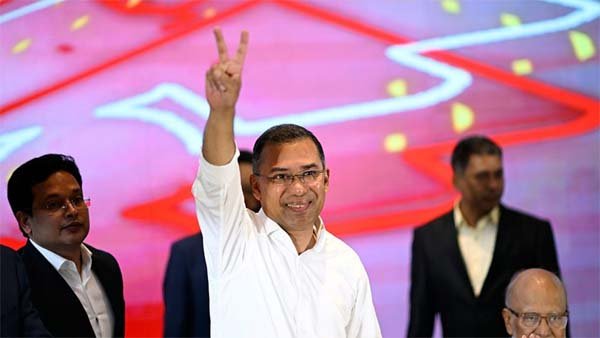
Dhaka, Feb 19 (UNI) The ruling Bangladesh Nationalist Party (BNP) stayed away from any move to push a “reset button” on the 1972 Constitution through amendment, repeal attempt or referendum proposals floated during the Yunus administration. Prime Minister Tarique Rahman took oath pledging to uphold the Constitution earned through the 1971 Liberation War.
Bangladesh Jamaat-e-Islami, however, was not pleased. The party did not join the swearing-in ceremony of the new Council of Ministers. Yet, the event carried a festive atmosphere and sent out multiple political signals.
At the South Plaza of the Jatiya Sangsad Bhaban in Dhaka, under the open sky, President Mohammad Shahabuddin administered the oath to the newly elected Prime Minister and his cabinet colleagues. Notably, Shahabuddin was appointed during the tenure of former Prime Minister Sheikh Hasina and has sworn in three heads of government over the past two and a half years.
Tarique Rahman surprised many by appointing Khalilur Rahman as Foreign Minister. Khalilur had earlier served as National Security Adviser during the Yunus period. Additionally, a woman has been appointed as State Minister for Foreign Affairs along with an adviser of equivalent rank. Known for maintaining close ties with the United States while balancing relations with India and China, Khalilur Rahman has been widely discussed at home and abroad over the past 18 months. Few had anticipated his inclusion in Tarique’s cabinet.
The new Prime Minister has sought a blend of youth and experience. Ten advisers with ministerial or state minister rank will work directly under him. Senior leaders have been accommodated alongside younger faces, signalling a calibrated generational shift.
Politicians who had supported reform and opposed dynastic politics during the military-backed caretaker government of January 2007 have found space in the cabinet. At the same time, figures who had opposed Tarique’s London-centric politics over the past 15 years have also been brought into the team, suggesting a departure from confrontational politics.
Senior leaders such as Mirza Abbas, Nazrul Islam Khan and Ruhul Kabir Rizvi have not been inducted into the cabinet but have been appointed as advisers to the Prime Minister with ministerial rank. The Finance Ministry has gone to a politician known for his success in business. Ehsanul Haque Milon has been given the Education portfolio, recalling his earlier tenure in the 2001 cabinet of Khaleda Zia.
The Home Ministry has been assigned to Salahuddin Ahmed, who had spent years in exile in India during the Awami League government, with allegations from his family that he had been forcibly disappeared before resurfacing across the border.
Among the mix of experienced and new faces, media-friendly Zahir Uddin Swapan has been made Information Minister, seen as adept at maintaining broad-based engagement.
The past 18 months under the Yunus-led administration were marked, according to critics, by instability and erosion of law and order. The restoration of stability and rule of law now stands as the principal challenge for the new government. Ordinary citizens seek peace and security, the ability to sleep at night without fear. Many believe that only the return of the effective rule of law can ensure that.
The new administration has also made clear its position on the Constitution. Unlike proposals during the Yunus period to scrap or overhaul the 1972 Constitution, Tarique Rahman’s government has chosen to retain the existing constitutional framework from day one.
The Jamaat-led alliance’s decision to boycott the oath ceremony is being closely watched. Despite Tarique Rahman visiting Jamaat Ameer Shafiqur Rahman and NCP Convener Nahid Islam with flowers after the election victory — a gesture seen as Western-style political courtesy ,their absence from the swearing-in has conveyed its own message about future political equations.
The open-air oath ceremony thus marked not only the formal beginning of a new administration, but also the start of a new phase in Bangladesh’s evolving political landscape.
(The writer is a former Editor of Bangladesh Pratidin. Views are personal.)