






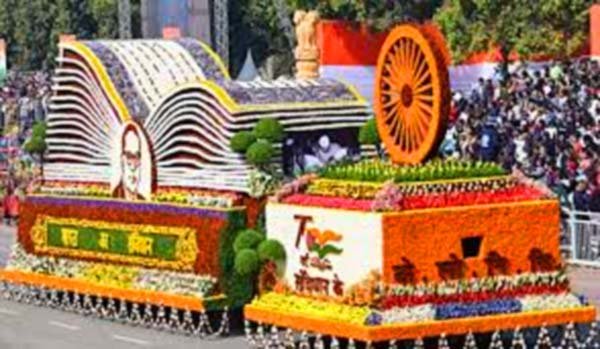
New Delhi, Jan 26 (UNI) Gujarat’s Republic Day tableau evocatively presented the theme “Mantra of Swadeshi- Self-Reliance- Freedom: Vande Mataram,” commemorating the 150th anniversary of the iconic national song that ignited India’s spirit of freedom and self-reliance.
The tableau paid homage to revolutionary Madam Bhikhaji Cama of Navsari, Gujarat, who carried India’s message of independence to the world alongside Shyamji Krishna Varma and Sardar Singh Rana. Her self-designed Vande Mataram flag, first unfurled in Paris in 1907 and later showcased at the Indian Socialist Conference in Stuttgart, was highlighted as a powerful symbol of India’s revolutionary voice on foreign soil.
At the forefront stood Madam Bhikhaji Cama holding the historic Vande Mataram flag, with the slogan inscribed below in multiple Constitution-recognised Indian languages. The central segment traced the evolution of India’s national flag, beginning with the Swadeshi movement at Parsi Bagan in Kolkata in 1906, followed by the Home Rule flag of 1917, Pingali Venkayya’s design presented to Mahatma Gandhi in 1921, its near adoption in 1931, and finally the acceptance of the tricolour with the Dharma Chakra by the Constituent Assembly on July 22, 1947.
The narrative seamlessly connected this legacy with Mahatma Gandhi’s promotion of Swadeshi through the charkha, underscoring its relevance to today’s vision of Aatmanirbhar Bharat. The tableau concluded with a sculpture of Gandhiji set against a grand Dharma Chakra, symbolising freedom achieved through self-reliance.
Adding cultural vibrancy, folk artists performed to Kasumbino Rang, composed by Zaverchand Meghani, infusing the presentation with patriotic fervour while honouring the sacrifices that shaped India’s freedom struggle and continue to inspire a self-reliant nation.