






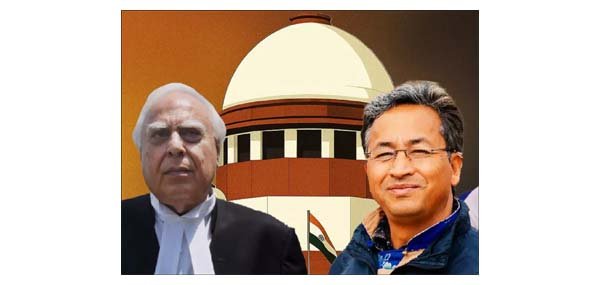
New Delhi, Jan 8 (UNI) The Supreme Court on Thursday heard at length a habeas corpus petition challenging the detention of Ladakh-based social activist Sonam Wangchuk under the National Security Act, 1980.
Senior Advocate Kapil Sibal alleged that material favourable to the detainee, specifically a speech appealing for peace, was deliberately suppressed by the detaining authority.
A Bench comprising Justice Aravind Kumar and Justice Prasanna Varale heard the matter for the entire second half of the day on a petition filed by Dr Gitanjali Angmo, wife of Sonam Wangchuk, assailing the detention order dated September 26, 2025, passed in the aftermath of protests in Ladakh that allegedly turned violent.
Appearing for the petitioner, Sibal contended that the detention order was vitiated by malice and non-compliance with constitutional safeguards under Article 22.
He submitted that the order was founded primarily on four videos relied upon by the detaining authority, dated September 10, September 11 and two dated September 24.
However, while the grounds of detention were supplied on September 29, the four videos forming the basis of the detention were not furnished to the detainee.
Sibal argued that it is settled law that the supply of grounds without the documents relied upon therein amounts to a violation of Article 22 of the Constitution, rendering the detention illegal.
Although the union claimed that all materials had been supplied, Sibal asserted that there was no proof to substantiate this claim.
He further submitted that the grounds of detention were furnished after an inordinate delay of 28 days, in clear breach of the statutory timeline.
According to Sibal, on September 29, Wangchuk was provided only with the detention order and incomplete grounds, as the four crucial videos were missing.
He pointed out that what was eventually supplied were mere links to the videos. Though a laptop was provided on October 5, Sibal argued that this did not cure the defect, since the pen drive supplied earlier did not contain the four videos relied upon.
Sibal informed the Court that Wangchuk had repeatedly written from custody, pointing out the non-supply of the videos and seeking copies, but to no avail. He also recounted that Wangchuk’s wife was assured copies of those letters but was not provided the documents despite waiting for over an hour and missing her flight.
Emphasising the settled legal principles, Sibal submitted that the non-supply of relied-upon documents vitiates a detention order.
He cited the Supreme Court’s decision in Ahmed v. union of India, where non-supply of a relied-upon bail application was held to violate the detainee’s right to make an effective representation.
He further relied on a consistent line of precedent to argue that it is immaterial whether the detainee already knew the contents of the documents, or whether the detainee had specifically demanded them. The constitutional obligation, Sibal stressed, lies squarely on the detaining authority to furnish all material relied upon.
Referring to the Khudiram Das case, Sibal submitted that it is the Court’s bounden duty to ensure that all constitutional and statutory safeguards are strictly observed and that no person is deprived of personal liberty except in accordance with law.
Sibal underlined that the right to make an effective representation under Article 22 is not a mere formality. A detainee must be afforded adequate time and material to meaningfully examine the grounds and decide the nature of representation to be made.
Terming the issue grave, Sibal argued that suppression of material favourable to the detainee goes to the root of the matter.
Drawing an analogy with recent Supreme Court rulings, he submitted that even material favourable to an accused must be disclosed if it forms part of the record.
In this context, Sibal played before the Court a video of Sonam Wangchuk dated September 24, in which Wangchuk is seen unequivocally appealing for peace and opposing violence.
He argued that while the detaining authority relied on another video of the same date to allege propagation of violence, it suppressed the video where Wangchuk spoke against violence.
According to Sibal, withholding such crucial material from the detaining authority itself demonstrated malice, which constituted an independent ground to invalidate the detention order.
“If the detaining authority relies on a video to say I am propagating violence, then fairness demands that it must also consider the video where I am clearly appealing against violence. Suppressing such material itself shows malice and vitiates the detention,” Sibal submitted.
The matter has been listed for further hearing on Monday at 2 pm.