





New Delhi, Dec 28 (UNI) The world’s fourth-largest rail system produced a year of unparalleled advancements that will revolutionise rail travel and logistics in India as it approaches 2026. These advancements included the introduction of next-generation trains, the modernisation of stations, the deployment of cutting-edge safety technologies, and the strengthening of regional connectivity.
In a statement issued here, the Ministry of Railways stated that after expanding the luxury of a comfortable travel to non-AC passengers through Amrit Bharat trains, Indian Railways is all set to soon operationalise first Vande Bharat Sleeper for AC class travellers.
In a paradigm shift in its catering, Railways is introducing local cuisine taste in various trains. Railways is also aiming to become a top carrier in freight services. Gati Shakti Cargo terminals, record number of wagon productions and running of more trains on the freight corridors are some inititiatives that are a part of this plan.
Prioritizing sustainability and innovation, Railways is moving towards eco-friendly and green operations while boosting the country’s economic progress with infrastructure improvements at large scales and capacity addition.
During the Calendar year-2025, Indian Railways introduced 15 Vande Bharat express trains. A total of 164 Vande Bharat train services are currently running across the Indian Railways network.
Amrit Bharat services, which are fully non-AC trains, presently comprising 12 Sleeper Class Coaches and eight General Class coaches, are providing high quality services to the passengers. During the calendar year-2025, 13 Amrit Bharat Express trains have been introduced and are operational. A total of 30 Amrit Bharat train services are running across the Indian Railways network.
Two Namo Bharat Rapid Rail Services have been operational in the country between Bhuj- Ahmedabad and Jaynagar- Patna. In 2025, Special Train operations were significantly scaled up to cater to seasonal rush, highlighting enhanced planning and a stronger focus on passenger comfort. The Indian Railway also operated a record number of over 43,000 special train trips during the year.
In order to cope with the rush during the Festival season and Summer vacation rush, 17,340 Special train trips for Maha Kumbh, 1,144 for Holi, 12,417 summer specials, and 12,383 for Chhath Puja were operated during the year.
In 2025, Indian Railways commissioned over 900 kilometres of new track lines. Besides laying the new tracks the focus is to renew the existing rail tracks to ensure safer, faster and comfortable travel.
To support this infrastructure expansion and maintenance, Indian Railways is modernising its track machinery. One tamping machine (HOT-3X) has been upgraded to the high-output 3X-Dynamic (HOT-S-3X) machine, integrating three-sleeper ballast packing with track stabilization.
These modernisation efforts are complemented by raising of sectional speeds to improve train operations and passenger convenience. Sectional speed has been increased to 130 kmph over 599 track kms, covering parts of the Golden Quadrilateral, Golden Diagonal, and other B routes. Further, speeds of 110 kmph have been achieved over 4,069 track kms, combining infrastructure upgrades with advanced track machinery to ensure faster, safer, and more efficient train operations.
Electrification of the railway network on Indian Railways (IR) has been taken up on a mission mode. Thus far, about 99.2 per cent of the Broad Gauge (BG) network has been electrified. Electrification in the remaining network has been taken up. This achievement is significantly higher than the electrification levels of the UK (39 pc), Russia (52 pc) and China (82 pc). A total of 14 Railway Zones and 25 States/Union Territories have now achieved 100 pc electrification.
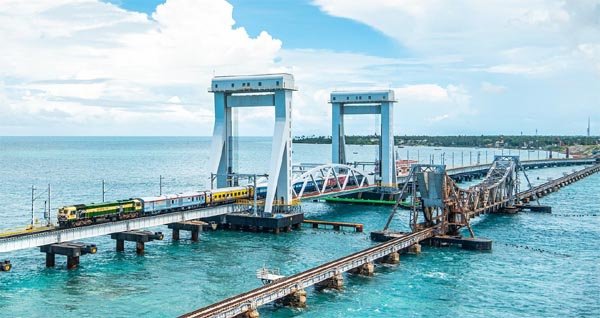
Notably, India opened its first vertical-lift rail bridge at Pamban, bolstered Kashmir’s connectivity with all-weather rail links (including the world’s highest Chenab bridge), and extended rail access into the Northeast with the new Bairabi-Sairang line.
The Udhampur- Srinagar -Baramulla Rail Link (USBRL), a 272 km project through the Himalayas, was completed and dedicated in 2025. It comprises 36 major tunnels and 943 bridges, reflecting exceptional engineering in one of the most challenging terrains in the world. The project features iconic engineering landmarks, including the world’s highest railway arch bridge ‘Chenab Bridge’, a 1,315 m steel arch over the Chenab River (359 m high), India’s first cable-stayed railway bridge ‘Anji Bridge’(deck 331 m above the river) and India’s longest operational railway tunnel ‘T-50’. Together, these three landmarks enable an all-weather rail route into Kashmir, cutting travel times by hours.
The 51 km Bairabi- Sairang broad-gauge line in Mizoram was inaugurated in September 2025, placing Aizawl on India’s rail map for the first time. Traversing rugged hills, the line includes 45 tunnels, 55 major bridges and 88 minor bridges.
The New Pamban Bridge, inaugurated on April 6, 2025, is India’s first vertical-lift railway sea bridge. The New Pamban Bridge, spanning a total length of 2.08 kilometres, connects Rameswaram to the Indian mainland. Spanning 2.08 km over the Palk Strait, it replaces the 110-year-old cantilever bridge, blending heritage with modern design. A 72.5 m central span can be lifted 17 m to let ships pass, and the deck is 3 m higher than the old bridge.