




Parwinder Sandhu
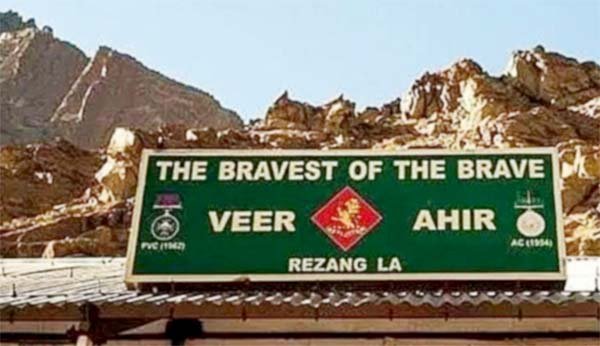
New Delhi, Nov 7 (UNI) “And how can man die better, Than facing fearful odds, From the ashes of his fathers, And the temples of the gods-” the lines from Thomas Babington Macaulay’s poem Horatius, now inscribed on the plaque welcome visitors at the Rezang La War Memorial in Chushul, Ladakh.
The war memorial got back into limelight following the release of 120 Bahadur’s trailer, a war drama by Farhan Akhtar, on Thursday. The movie is based on the battle of Rezang La, a part of the 1962 India-China war. For the world Rezang La war memorial is to commemorate the valour of the fallen heroes, but it holds a poignant tale of camaraderie and brotherhood that the Indian Army is known for.
The memorial is one of its kind in the world as it also holds a cremation ground, known as Ahir Dham.
It was November 18, 1962, amid bone-numbing cold and thin air at 16,420 feet, 120 men of Charlie Company, 13th Kumaon Regiment, led by the fearless Major Shaitan Singh Bhati, Param Vir Chakra, stood their ground against thousands of Chinese soldiers to protect Rezang La point located at the south-eastern ridge of the Chushul Valley, under the aegis of 114 Brigade in Ladakh.
Cut off from reinforcements, communication lines severed, and artillery support unavailable, the heroes fought till the very last man and the very last bullet, ensuring not an inch of Indian soil fell into enemy hands.
For months after that, nobody knew the fate of these soldiers, their bodies, perfectly frozen in time, unknown to their families, unknown to the world around them. It was only in February 1963 when a search party of the Indian army unearthed the snow-covered corpses on the battlefield, some still clinging on to their guns and others in crouched positions.
The bodies were brought down to Chushul plains. However, the authorities were faced with yet another dilemma of dealing with the martyrs as given the terrain and limited resources, it was not possible to send the bodies home.
It was then decided that only Major Shaitan Singh’s body will be sent to his hometown in Jodhpur, Rajasthan, while the rest of the martyrs will be cremated together with full military honours in Chushul itself. The then brigade commander, Brigadier T.N. Raina, undertook the task of cremating the martyrs in a community pyre. However, given the barren landscape with not even a blade of grass or twig in sight, it was impossible to build a pyre.
It was then decided that the pyre would be built using furniture from the officers’ mess, living quarters and offices of the brigade.
The pyre was finally built. Bodies laid. Rituals performed for the soldiers’ final journey. There in the midst of cold, barren landscape, the pyre left everyone in tears, standing and witnessing as the martyrs bid their final goodbye.
Most of the soldiers belonged to the Ahir community who hailed from Gurgaon and Mewat of Haryana. To commemorate their sacrifice, the place where the pyre was lit was later named Ahir Dham. Covered in white marble surrounded by the serene sound of fluttering flags, it stands right in the middle of Rezang La war memorial. The tombstone reads, “This sacred place bears testimony to the resolute valour, indomitable courage and conspicuous bravery of these brave hearts and is a source of inspiration for one and all.”