





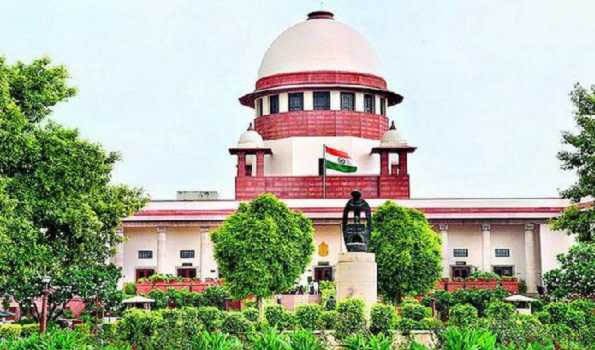
New Delhi, Jan 13 (UNI) The Supreme Court today underscored that ensuring admission of children from weaker and disadvantaged sections in private schools under the Right to Education (RTE) Act must be treated as a “national mission.”
Interpreting Section 12(1)(c) of the Right of Children to Free and Compulsory Education Act, 2009, the Court held that State governments and local authorities are duty-bound to ensure that no eligible child is denied admission in neighbourhood schools.
It further ruled that private unaided and special category schools are equally obligated to admit such children to the extent of 25 per cent of their intake, in line with the RTE Act and Article 21A of the Constitution.
A Bench comprising Justice P.S. Narasimha and Justice A.S. Chandurkar issued a series of directions to ensure effective implementation of the provision and kept the matter pending for compliance.
The Court also impleaded the National Commission for Protection of Child Rights as a party and directed it to file an affidavit.
Under Section 12(1)(c) of the RTE Act, private unaided schools and special category schools are required to provide free and compulsory education to at least 25 per cent children belonging to weaker sections and disadvantaged groups at the entry-level classes.
These schools are entitled to reimbursement of expenses at the per-child cost incurred by the government.
The Bench observed that meaningful implementation of the 25 per cent quota has the potential to bring about far-reaching social change.
It said the obligation of neighbourhood schools to admit children from weaker sections has the capacity to transform society by promoting equality of status, which is a core constitutional value.
Justice Narasimha observed that the constitutional guarantee of the right to education under Article 21A, read with the RTE Act, can be realised only through effective and sincere implementation.
He added that courts, whether constitutional or civil, must go the extra mile to ensure easy access to justice and prompt relief for parents whose children are denied admission under the RTE quota.
The case arose from a special leave petition challenging a Bombay High Court order dated December 20, 2016, which had dismissed a plea seeking admission of the petitioner’s children under the 25 per cent free education quota.
The High Court had held that the petitioner failed to apply under the said quota during the online admission process and therefore could not seek relief later.
Setting aside the approach adopted by the High Court, the Supreme Court emphasised that procedural lapses should not defeat the fundamental right to education of children belonging to weaker sections, and that authorities must proactively ensure compliance with the mandate of the RTE Act.